
Electrical panels are not exactly the glamour corner of a home. They sit in garages, basements, hallways, laundry rooms, and occasionally in the one wall directly behind a bed, desk, crib, or favorite reading chairbecause home layouts apparently enjoy practical jokes. If you have started wondering how to block EMF from an electrical panel, you are not alone.
First, let’s keep this practical. EMF stands for electromagnetic field. In a typical home electrical panel, the main concern is usually extremely low frequency EMF, often called ELF-EMF, produced by 60-hertz electrical current, household wiring, breakers, and connected loads. This is different from radiofrequency radiation from Wi-Fi, cell phones, Bluetooth devices, or smart meters. In plain English: your breaker panel is not secretly broadcasting TikTok. It is mostly carrying power.
The goal is not panic. The goal is smart exposure reduction, better electrical safety, and common-sense home design. Research on residential low-frequency EMF and health has been debated for decades, and major health organizations generally describe the evidence as mixed, limited, or weak rather than settled proof of harm. Still, many homeowners prefer a precautionary approach, especially when a bed, nursery, sofa, or office chair sits directly on the opposite side of the electrical panel.
The good news: you can reduce exposure without turning your house into a science-fiction bunker. The even better news: most effective steps are boring, affordable, and practical. The less good news: wrapping your electrical panel in foil is not one of them. Please do not mummify your breaker box.
Understanding EMF from an Electrical Panel
What kind of EMF comes from a breaker panel?
An electrical panel can produce both electric fields and magnetic fields. Electric fields are related to voltage. Magnetic fields are related to current flow. When appliances, HVAC systems, lights, chargers, pumps, ovens, dryers, or other loads are running, current moves through the service conductors, breakers, neutral bars, and branch circuits. That current can create a magnetic field around the panel and nearby wiring.
Magnetic fields are the trickier part. Common shielding materials that help block radiofrequency radiation do not always work well against low-frequency magnetic fields. A thin sheet of ordinary aluminum may help with some electric fields and high-frequency signals, but it will not magically erase a 60-hertz magnetic field from a loaded panel. Low-frequency magnetic shielding often requires specialized high-permeability materials, careful installation, and testing.
Why distance matters so much
One of the most reliable ways to reduce EMF exposure is distance. Electric and magnetic fields generally drop as you move away from the source. That is why a panel that measures high at the wall may measure much lower a few feet away. In many homes, moving a bed or workstation even two to four feet can make a meaningful difference.
This is also why the room on the other side of the panel matters more than the garage wall itself. A breaker box in the garage is usually no big drama if nobody spends eight hours pressed against the wall behind it. A panel behind a pillow, baby crib, or home office chair deserves a closer look.
Before You Block Anything: Measure First
Before spending money on EMF shielding fabric, metal sheets, specialty paint, or a consultant with a toolbox and dramatic eyebrows, measure. Guessing is where homeowners lose money. Measuring tells you whether the panel is actually a problem, where the field is strongest, and whether your solution worked.
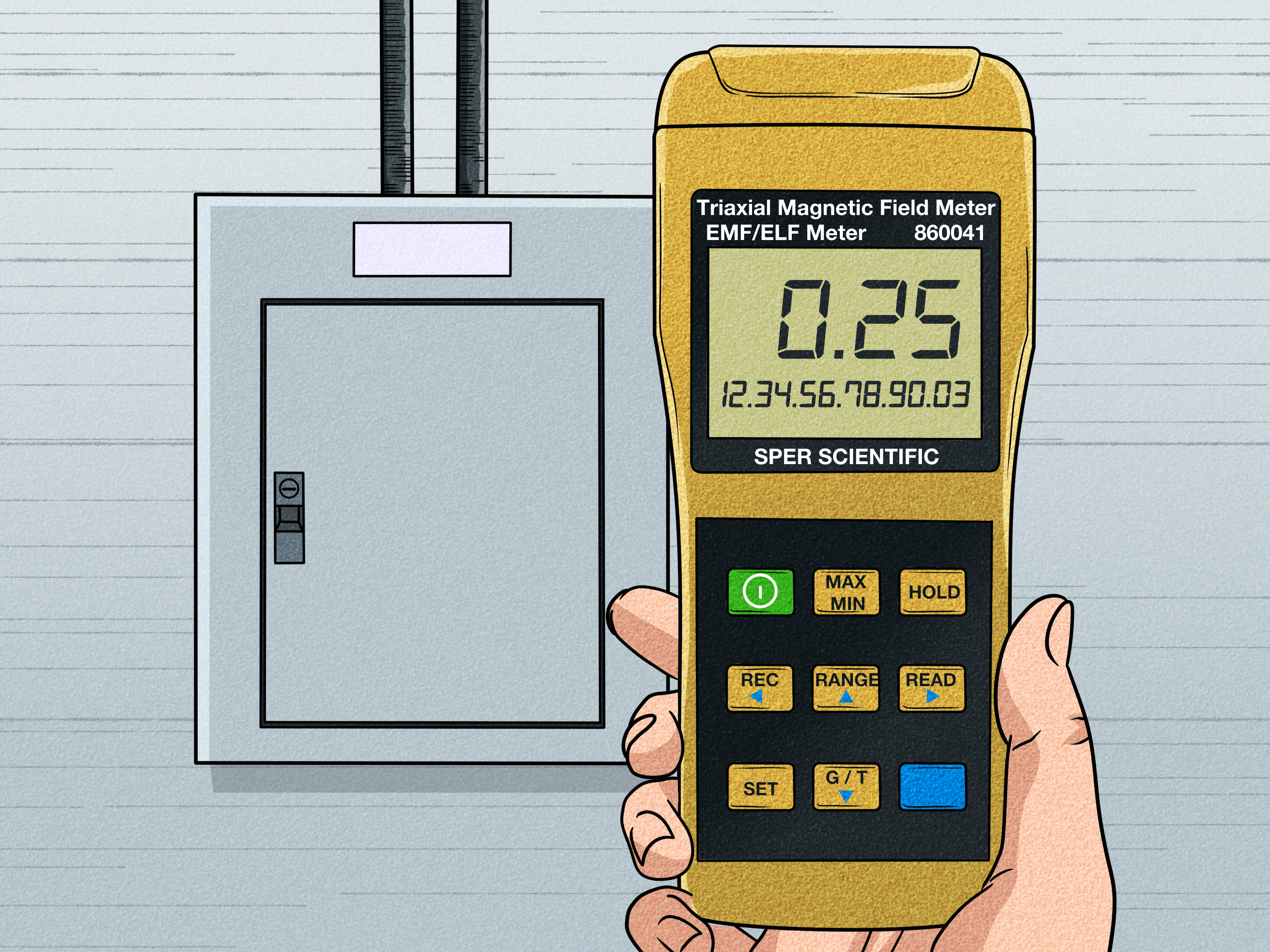
For low-frequency magnetic fields, use a gauss meter or milligauss meter that can measure 50/60 Hz magnetic fields. Take readings directly at the wall, one foot away, three feet away, and at the exact height where a person spends time. For example, measure at pillow height, desk-chair height, crib height, and sofa height. Measure when major loads are off and again when big appliances are running. Turn on the dryer, oven, HVAC, dishwasher, or electric water heater if they are part of the home’s electrical load.
You may discover that the panel is not the main source. Sometimes the bigger EMF source is a refrigerator motor, an electric meter, a transformer, knob-and-tube wiring, poorly routed circuits, net current on grounding paths, or wiring errors. The panel gets blamed because it looks suspicious. It is the electrical equivalent of a guy wearing a trench coat in a movie.
1. Increase Distance from the Panel
The simplest way to block EMF from an electrical panel is to block your daily contact with the strongest field zone. That means rearranging the room so people do not sleep, work, or relax directly beside the panel wall.
Move beds, desks, and cribs away
If a bed is on the opposite side of the electrical panel, pull it away from that wall or rotate it to another wall. The same applies to a crib, play area, reading chair, gaming setup, or home office desk. Long-duration exposure matters more than a quick walk past the panel. You do not need to avoid the hallway like it contains lava. You simply want to avoid spending six to eight hours with your head inches from the panel.
As a practical target, create as much distance as your floor plan allows. Even a few feet can help. If the panel is behind a bedroom wall, place a dresser, bookshelf, closet storage, or decorative cabinet on that wall instead of a bed. The furniture itself is not a magical EMF shield, but it creates distance and prevents people from parking their bodies in the strongest zone.
Use the “low-time wall” strategy
A smart layout trick is to assign the panel wall to low-time activities. Use that wall for storage, artwork, seasonal bins, laundry baskets, or a hallway console. Avoid placing the head of a bed, a nursery chair, a meditation spot, or a desk directly against it.
This method is inexpensive, code-friendly, and does not interfere with electrical access. It is also renter-friendly. You do not need to open walls, modify wiring, or ask a landlord whether you may install mysterious magnetic alloy panels. You just need a tape measure and the courage to move furniture without pretending it will “only take five minutes.”
2. Keep the Electrical Panel Clear and Accessible
One of the biggest mistakes people make when trying to block EMF from a breaker panel is covering the panel itself. Do not do this. Electrical panels require safe working clearance so electricians can inspect, service, and shut off power quickly. Blocking access with furniture, storage boxes, permanent panels, insulation, fabric, or decorative covers can create a real safety problem.
Do not cover the breaker box
An electrical panel is not a picture frame. It needs to open fully. It should not be hidden behind a bookcase, nailed-over wall panel, heavy mirror, or DIY “shielding box.” If a breaker trips, a wire overheats, or an electrician needs access, seconds matter. A clever cover that delays access is not clever; it is a fire-safety plot twist.
For most residential panel areas, keep a clear working space in front of the electrical equipment. A common safety rule is at least 30 inches of width and about 36 inches of depth in front of the panel, with enough headroom and the ability for the panel door to open properly. Local code requirements vary, so a licensed electrician should confirm the rules in your area.
Use barriers only away from the panel face
If you add shielding, it usually belongs on the living-space side of the wall or within a professionally planned wall assemblynot over the panel cover. For example, if a panel is in the garage and the bedroom is behind it, shielding may be considered on the bedroom side of that wall. The panel face must remain accessible.
This distinction matters. You are trying to reduce exposure in occupied spaces, not seal electrical equipment inside a homemade vault. Panels need ventilation, service access, visibility, and safe working clearance. Any shielding project must respect electrical safety first.
3. Have an Electrician Check Wiring, Load, and Grounding
Sometimes the best way to reduce EMF near an electrical panel is not shielding at all. It is fixing the electrical system. Unbalanced loads, shared neutrals, wiring errors, loose connections, improper grounding, or current traveling where it should not can increase magnetic field readings in certain areas.
Ask for a real electrical inspection
Hire a licensed electrician to inspect the panel, grounding system, neutral connections, branch circuits, and major loads. Tell the electrician exactly what you are investigating: elevated magnetic field readings near the panel or on the opposite wall. This helps them look for wiring patterns that may contribute to unnecessary fields.
A qualified electrician may check whether circuits are properly paired, whether neutrals and hots are routed together, whether there is objectionable current on grounding conductors, whether older wiring needs correction, and whether heavy loads are balanced. These are not casual DIY tasks. Electrical panels can injure or kill. This is not the place to “learn as you go” from a comment thread written by someone named BreakerBro77.
Watch for warning signs
Even if your main concern is EMF, pay attention to safety clues. Frequently tripping breakers, buzzing sounds, warm outlets, flickering lights, burning smells, discolored receptacles, or appliances that repeatedly overload a circuit are reasons to call an electrician. These problems matter far more urgently than EMF readings.
Do not replace a breaker with a higher-amp breaker to stop nuisance trips. A breaker is a safety device, not a suggestion box. If it trips, the system is telling you something. Masking the symptom can increase fire risk. Proper repair may also reduce abnormal current paths that contribute to magnetic field issues.
4. Install a Professional Low-Frequency Magnetic Shield
If measuring confirms that the electrical panel creates elevated readings in a long-use area, and furniture changes are not enough, shielding may be worth considering. This is where expectations need to be realistic. Blocking low-frequency magnetic fields is not the same as blocking Wi-Fi. Magnetic fields can pass through many ordinary materials.
Use the right shielding material
Low-frequency magnetic shielding typically uses high-permeability metals or specialty magnetic shielding alloys. These materials help redirect magnetic flux. Common examples in engineering contexts include mu-metal-style alloys, silicon steel, specialty magnetic shielding foil, or layered systems designed for low-frequency fields.
Ordinary drywall, wood, plastic, curtains, rugs, plants, and most decorative panels do little for 60-hertz magnetic fields. Standard aluminum foil is not a reliable solution for panel-related magnetic fields. Some EMF paints are designed mainly for electric fields or radiofrequency shielding, so they may not solve a low-frequency magnetic field problem by themselves.
Shield the occupied side, not the panel
A practical project might involve installing shielding material on the bedroom or office side of the wall behind the panel, then covering it with drywall or another finished surface. The exact material, layer count, seams, grounding requirements, and placement should be designed around actual measurements. Shielding can fail if installed in the wrong location, cut around too many gaps, or placed without understanding field direction.
For best results, measure before installation, during installation, and after installation. The goal is not to buy the shiniest product. The goal is a documented reduction at the location where people spend time. If the pillow-height reading drops meaningfully, that is a win. If the meter barely changes, the wall just became more expensive.
Consider professional EMF assessment
For complicated homes, older wiring, bedrooms directly behind main service equipment, or unusually high readings, a trained EMF consultant working alongside a licensed electrician may be useful. The consultant can map fields; the electrician can correct electrical causes and make sure safety rules are followed. The two roles are different, and both matter.
Common Mistakes to Avoid
Mistake 1: Wrapping the panel in foil
Please do not wrap an electrical panel in foil or metal mesh. It may block access, create sharp conductive surfaces, interfere with safe operation, and still fail to reduce the magnetic field you care about. This is a classic example of a fix that looks scientific while behaving like chaos in a shiny hat.
Mistake 2: Blocking the panel with furniture
Moving a bed away from the panel wall is smart. Shoving a bookcase directly in front of the breaker box is not. The panel needs clear access for emergencies and maintenance.
Mistake 3: Buying shielding before measuring
Shielding products can be expensive. Some are useful for specific frequencies and useless for others. Measure first. Match the solution to the field type. Then test again.
Mistake 4: Ignoring electrical defects
If your panel has buzzing, heat, corrosion, scorch marks, frequent trips, outdated breakers, or suspicious wiring, do not treat this as an EMF decorating problem. Treat it as an electrical safety issue.
Simple Step-by-Step Plan
Step 1: Identify occupied areas
Find out what is on the other side of the electrical panel. Bedroom? Office? Nursery? Closet? Garage? Storage room? Prioritize areas where people spend long periods.
Step 2: Measure magnetic fields
Use a meter designed for low-frequency magnetic fields. Take readings at several distances and during different electrical loads. Write them down. A simple notebook works fine. A spreadsheet works too, if you enjoy making your home nervous.
Step 3: Rearrange the room
Move beds, desks, cribs, and seating away from the strongest area. Re-measure. This may solve the problem without construction.
Step 4: Call an electrician if readings are unusual
If readings are high, inconsistent, or spread strangely through the house, have a licensed electrician inspect the panel and wiring. Safety comes first.
Step 5: Add professional shielding only if needed
If the room layout cannot change and measurements remain elevated, consider a properly designed low-frequency magnetic shield on the occupied side of the wall.
Real-World Experience: What Usually Works Best
In real homes, the most successful EMF reduction projects are usually not dramatic. They are quiet, practical, and slightly annoying because they require measuring, moving furniture, and calling professionals instead of buying one magic product online. But that is exactly why they work.
Imagine a homeowner who discovers that the main electrical panel is in the garage, directly behind the headboard in a guest bedroom. The first instinct might be to buy shielding fabric or special paint. A better first move is to measure. At the wall, the meter may show a higher reading when the HVAC system and dryer are running. Two feet away, the reading may drop sharply. After rotating the bed to another wall, the sleeping area may test much lower. Total cost: sweat, furniture sliders, and perhaps one argument about where the nightstand should go.
Another common situation involves a home office. A desk sits on the wall behind the breaker panel. The homeowner spends nine hours a day there, wondering why the panel suddenly feels suspicious. Measurements show that the strongest area is right where the chair sits. Moving the desk across the room reduces the reading at the seated position. The panel remains exactly where it was, but the exposure pattern changes. This is the “distance beats drama” principle in action.
Then there are cases where rearranging furniture does not solve enough. In one example, a nursery shares a wall with a service panel and large electrical loads. The crib can move, but not very far. Measurements still show elevated readings in the sleeping area during peak load. In that kind of case, the best path is usually a two-part approach: an electrician checks for wiring issues, and a shielding specialist designs a magnetic shield for the nursery side of the wall. After installation, the area is measured again. The homeowner now has numbers instead of anxiety.
One important lesson from these experiences is that the panel is not always guilty. Sometimes a meter points to current on a metal water pipe, a wiring error, an old shared-neutral circuit, or a nearby appliance. That is why a good inspection can save money. Shielding the wrong wall is like wearing a raincoat indoors while the roof leaks.
The most practical mindset is simple: reduce long-duration proximity, preserve electrical safety, fix defects, and use shielding only when measurements justify it. You do not need to become afraid of your electrical system. You do need to respect it. The best homes are not zero-EMF fantasy bubbles; they are safe, well-wired, thoughtfully arranged spaces where the panel does its job without becoming the star of the floor plan.
Conclusion
Blocking EMF from an electrical panel is less about fear and more about smart home planning. Start with measurement, because guessing leads to wasted money. Increase distance from the panel, especially for beds, desks, cribs, and long-use seating. Keep the panel clear and accessible for safety. Ask a licensed electrician to inspect wiring, grounding, and load issues if readings seem unusual or if the panel shows warning signs. If needed, use professionally designed low-frequency magnetic shielding on the occupied side of the wall, not over the breaker box itself.
The simple version: do not wrap the panel, do not block access, and do not trust one-size-fits-all EMF products. Measure, move, repair, and shield only when necessary. Your electrical panel should quietly power your homenot become a mysterious wall monster.












