
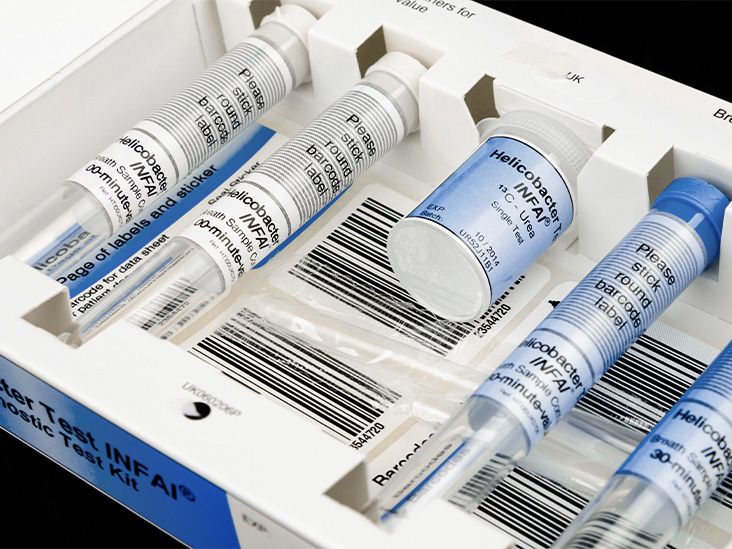
A test that involves little more than drinking a small solution and breathing into a bag sounds suspiciously easy for something that can detect a potentially troublesome stomach infection. Yet that is essentially what happens during an H. pylori breath test.
Also known as a urea breath test (UBT), this noninvasive test looks for an active infection with Helicobacter pylori, a bacterium that can live in the stomach lining. H. pylori infection is associated with chronic gastritis and peptic ulcers and, over the long term, can increase the risk of certain stomach cancers.
The test itself is usually quick and painless. The preparation is where patients need to pay attention. Acid-reducing medicines, antibiotics, and bismuth products can sometimes suppress the bacteria enough to create a false-negative result. In other words, H. pylori may still be throwing a party in your stomach while the test mistakenly reports that everyone went home.
Here is how the H. pylori breath test works, how to prepare correctly, what happens during the appointment, and what your results may mean.
What Is an H. pylori Breath Test?
The H. pylori breath test is a diagnostic test designed to detect active H. pylori infection. Unlike a blood antibody test, which may remain positive long after an old infection has disappeared, a properly performed urea breath test looks for evidence that the bacteria are currently active.
The test takes advantage of one of H. pylori’s biological talents: producing an enzyme called urease.
Urease allows H. pylori to break down urea. During the breath test, you swallow specially labeled urea. If H. pylori bacteria are living in your stomach, their urease enzyme breaks that urea apart, creating ammonia and labeled carbon dioxide.
The carbon dioxide enters your bloodstream, travels to your lungs, and eventually leaves your body when you exhale. Laboratory equipment compares your breath before and after you swallow the urea. A significant increase in labeled carbon dioxide suggests that H. pylori is present.
It’s clever chemistry wrapped in a remarkably uneventful medical appointment.
Why Doctors Order an H. pylori Breath Test
A healthcare professional may recommend testing when symptoms or medical history suggest gastritis, peptic ulcer disease, or another condition associated with H. pylori.
Possible reasons for testing include:
- Persistent or recurring upper abdominal discomfort
- Burning or gnawing stomach pain
- Nausea or frequent indigestion
- Unexplained bloating
- A history of stomach or duodenal ulcers
- Certain gastric precancerous conditions
- A need to confirm that previously treated H. pylori has been eliminated
The last reason is especially important. Current gastroenterology guidance recommends confirming eradication after H. pylori treatment rather than assuming that finishing the antibiotics automatically means the infection is gone.
When a Breath Test May Not Be the Only Test Needed
A breath test is useful for detecting H. pylori, but it cannot show what the inside of your stomach looks like. Someone with concerning symptoms may need an upper endoscopy instead of, or in addition to, noninvasive testing.
Seek medical evaluation promptly for symptoms such as vomiting blood, black or tarry stools, unexplained weight loss, significant anemia, persistent vomiting, or difficulty swallowing. Those situations deserve more investigation than simply blowing into a bag and hoping for the best.
How the H. pylori Breath Test Works
Step 1: A Baseline Breath Sample Is Collected
Before swallowing anything, you provide a baseline sample of your breath. Depending on the testing system, you may exhale into a collection bag or another device.
This sample establishes the normal amount and ratio of carbon isotopes in your breath before the labeled urea enters your stomach.
Step 2: You Swallow Labeled Urea
Next, you drink a prepared solution or swallow another approved formulation containing labeled urea.
Many modern U.S. testing systems use carbon-13 urea. Carbon-13 is a naturally occurring, stable, nonradioactive isotope. Some other urea breath testing methods have historically used carbon-14, which is radioactive, so the exact product matters.
Follow the instructions for the specific test kit being used rather than assuming every H. pylori breath test is identical.
Step 3: You Wait
After swallowing the urea preparation, you usually sit quietly while the substance reaches your stomach and any H. pylori present gets to work.
With commonly used systems, the wait may be around 15 minutes, although timing varies according to the product and laboratory protocol.
Step 4: A Second Breath Sample Is Collected
You then provide another breath sample.
If H. pylori is present, its urease enzyme has broken down some of the labeled urea, producing labeled carbon dioxide. The laboratory compares the before-and-after samples.
An increase beyond the test’s established cutoff indicates a positive result.
How to Prepare for an H. pylori Breath Test
Preparation matters because certain medications can temporarily reduce H. pylori activity. That can produce a false-negative H. pylori breath test.
The most important rule is simple: follow the instructions from the healthcare professional and laboratory performing your specific test. Different test kits and clinical situations can have slightly different requirements.
PPIs May Need to Be Stopped
Proton pump inhibitors, commonly called PPIs, strongly suppress stomach acid and may interfere with H. pylori testing.
Examples include:
- Omeprazole
- Esomeprazole
- Lansoprazole
- Pantoprazole
- Rabeprazole
- Dexlansoprazole
For a post-treatment test of cure, the American College of Gastroenterology recommends being off PPIs and potassium-competitive acid blockers, or PCABs, for at least two weeks before testing.
Do not stop a prescription medication on your own. Ask your clinician what to use if you need temporary relief from heartburn or ulcer symptoms.
Antibiotics Can Affect the Result
Antibiotics may temporarily suppress H. pylori and make an infection harder to detect.
For testing after H. pylori treatment, current ACG guidance recommends waiting at least four weeks after completing antibiotics before performing a breath test, stool antigen test, or appropriate biopsy-based test to confirm eradication.
Some individual laboratory test-kit instructions use different medication windows for initial diagnostic testing, which is another reason to follow the directions attached to your order.
Bismuth Products Matter Too
Bismuth-containing medicines such as bismuth subsalicylate can also affect H. pylori detection.
Many laboratories instruct patients to avoid bismuth preparations for a specified period before testing. The exact interval can depend on the protocol, so check rather than guessing.
What About H2 Blockers and Antacids?
H2 receptor blockers include medicines such as famotidine and cimetidine. Their instructions vary among testing protocols.
ACG guidance notes that H2 receptor antagonists and antacids may sometimes be used as temporary “bridge” therapy while PPIs are being withheld before a post-treatment test.
However, an individual testing center may ask you not to take certain products on the day of your appointment. Follow the laboratory’s instructions.
Do You Need to Fast?
Common U.S. laboratory protocols for certain carbon-13 breath tests require fasting for at least one hour before the baseline sample.
Some clinics may give different fasting instructions based on their equipment or test kit.
If your paperwork says no food for a certain period, take it seriously. This is not the ideal morning to decide that one tiny breakfast burrito surely doesn’t count.
Smoking, Gum, and Drinks
Depending on the test protocol, patients may also be instructed to avoid smoking, chewing gum, alcohol, carbonated drinks, or other activities shortly before testing.
Ask specifically whether plain water is allowed. Some testing systems permit it during the fasting period, while your clinic may provide its own instructions.
A Simple Preparation Checklist
- Confirm whether this is an initial diagnostic test or a post-treatment test of cure.
- Give your healthcare professional a complete medication list.
- Ask when to stop PPIs or PCABs.
- Tell the clinic about recent antibiotic use.
- Ask about Pepto-Bismol or other bismuth-containing medicines.
- Clarify whether H2 blockers and antacids are permitted.
- Follow the required fasting period.
- Do not change prescribed medication without medical guidance.
How Long Does an H. pylori Breath Test Take?
The active testing portion is usually fairly short. Some commonly used testing systems can complete sample collection in roughly 20 to 25 minutes.
A typical appointment involves checking your preparation, collecting the first breath sample, drinking the urea mixture, waiting about 15 minutes, and collecting the second sample.
No needles are normally required. There is no anesthesia, no scope down your throat, and generally no recovery period afterward.
Unless your healthcare team says otherwise, you can typically resume normal activities after the test.
What Does the Urea Solution Taste Like?
This varies by test product. Some preparations are fruit-flavored or contain citric acid. Others may taste mildly sour or simply medicinal.
The amount is generally small, and drinking it takes only a few moments. For most patients, taste is considerably less dramatic than whatever horror story their imagination constructed in the parking lot.
Are There Side Effects?
The H. pylori breath test is generally considered noninvasive and well tolerated. Most people have no meaningful side effects from the testing process.
However, patients should tell the healthcare team about pregnancy, breastfeeding, phenylketonuria, allergies, significant medical conditions, or difficulty swallowing before testing. Test formulations differ, and some products have specific precautions.
Children also require an age-appropriate test and must be able to follow the breathing and collection instructions correctly.
Understanding H. pylori Breath Test Results
What Does a Positive Result Mean?
A positive urea breath test generally indicates an active H. pylori infection.
Your healthcare professional will usually discuss eradication treatment, which commonly involves multiple medications, including antibiotics and acid suppression.
Because antibiotic resistance influences treatment success, the specific regimen should be chosen by a qualified clinician rather than assembled from leftover pills in the bathroom cabinet.
What Does a Negative Result Mean?
A properly performed negative test makes active H. pylori infection less likely.
However, a negative result deserves extra scrutiny when preparation instructions were not followed. Recent PPIs, antibiotics, bismuth medications, or other interfering treatments may suppress bacterial activity and contribute to a false negative.
If your symptoms and medical history strongly suggest H. pylori despite a negative test, your clinician may recommend repeating testing under better conditions or using another diagnostic method.
H. pylori Breath Test vs. Stool Test
Both the urea breath test and stool antigen testing can detect active H. pylori infection and can be used to confirm eradication after treatment.
The breath test avoids stool collection and can be completed during a short clinical visit. The stool antigen test can be convenient when collecting a breath sample is difficult or when local availability and cost favor stool testing.
Blood antibody testing has an important disadvantage: antibodies can remain detectable after the bacteria have been eliminated. As a result, a blood test generally cannot reliably prove that treatment succeeded.
H. pylori Breath Test vs. Endoscopy
A breath test answers a relatively focused question: is there evidence of active H. pylori infection?
Upper endoscopy can answer many additional questions. A gastroenterologist can inspect the esophagus, stomach, and duodenum and take biopsies when necessary.
Endoscopy is therefore more appropriate when doctors need to investigate bleeding, ulcers, suspicious lesions, severe persistent symptoms, or other structural problems. It is more invasive, however, and often involves sedation.
For straightforward H. pylori testing without alarm features, a breath or stool test may provide the information needed without turning the appointment into a full gastrointestinal camera expedition.
Testing After H. pylori Treatment
Feeling better does not necessarily prove that H. pylori has been eradicated.
Current ACG recommendations call for proof of eradication in patients treated for H. pylori. Acceptable methods include an appropriately performed urea breath test, stool antigen test, or biopsy-based testing in selected situations.
For a test of cure, testing should be performed at least four weeks after completing antibiotics. PPIs and PCABs should generally be withheld for at least two weeks beforehand under medical guidance.
This waiting period is not pointless bureaucracy. Testing too soon can make lingering infection harder to detect.
Common H. pylori Breath Test Mistakes
Stopping Medication Without Asking
Correct preparation matters, but abruptly stopping prescribed medication may not be safe for everyone. Get instructions from your clinician.
Forgetting About Over-the-Counter Products
Patients often remember prescription antibiotics but forget that medications such as Pepto-Bismol may also affect testing.
Taking a PPI Because It “Doesn’t Count as Medicine”
It most definitely counts.
Over-the-counter omeprazole, esomeprazole, and lansoprazole are still PPIs even if they came from a grocery-store shelf rather than a pharmacy counter.
Testing Too Soon After Treatment
If you finished H. pylori antibiotics last Tuesday, scheduling a test of cure this Friday is usually premature. Proper timing improves confidence in the result.
Assuming Every Laboratory Uses the Same Protocol
Different approved testing systems may have different instructions regarding fasting, medication timing, sample collection, and patient eligibility. Your own testing center’s instructions should win any argument with a random checklist found online.
What the H. pylori Breath Test Experience Is Really Like
For many patients, the anticipation is more complicated than the test itself. The words “breath test” can sound vaguely technical, and the mention of labeled urea does not exactly improve the marketing campaign. In practice, the appointment is usually surprisingly ordinary.
Imagine a patient named Daniel who has dealt with months of upper abdominal burning and intermittent nausea. His clinician orders an H. pylori urea breath test. Daniel receives instructions explaining that his PPI needs to be withheld for the appropriate period under medical supervision and that he must follow the laboratory’s fasting requirements.
The medication change is the most annoying part. Without his usual acid-suppressing medicine, Daniel notices some heartburn. His clinician has already explained what temporary alternatives he can use, preventing him from making the common mistake of secretly taking the PPI the night before the test “just this once.”
On testing day, he checks in and answers questions about medications and recent antibiotic use. A technician gives him a collection bag and explains how to provide the baseline sample.
He breathes into it.
That’s it. No applause. No dramatic medical soundtrack.
Next comes the urea preparation. He drinks it according to the instructions. The flavor is not something he plans to order with dinner, but it is perfectly manageable. Then he waits.
This waiting period is often the longest part of the appointment. Patients may be asked to sit quietly for around 15 minutes while the labeled urea interacts with anything interesting enough to be living in the stomach.
Daniel then provides the second breath sample. The entire collection process is finished without needles, sedation, an IV, or someone asking him to count backward from 100.
He returns to his normal routine afterward.
A few days later, depending on the laboratory’s processing time, his clinician receives the result. If the test is positive, Daniel can discuss treatment. If he had recently completed H. pylori therapy and this were a test of cure, a negative result obtained with proper timing and preparation would provide evidence that treatment worked.
This example highlights an important reality: the hardest part of an H. pylori breath test is often preparing correctly rather than undergoing the test.
Patients can make the process smoother by writing down every prescription drug, over-the-counter medication, and stomach remedy they use before discussing preparation with the clinic. A photograph of medication bottles on a phone can be surprisingly useful when nobody remembers whether the “little purple pill” is an antacid, PPI, H2 blocker, or something entirely unrelated.
It also helps to ask questions early. If the instruction sheet says to stop a medication for two weeks but the appointment is tomorrow, call the testing center rather than hoping the bacteria will respect your scheduling conflict.
Finally, do not judge the usefulness of the test by how simple it feels. The urea breath test works because it measures a very specific biological reaction produced by H. pylori. Behind those two humble bags of exhaled air is a carefully designed biochemical test capable of helping clinicians diagnose an active infection and confirm whether treatment succeeded.
Conclusion
The H. pylori breath test is a fast, noninvasive way to detect active Helicobacter pylori infection and to check whether treatment has successfully eradicated the bacteria.
The science is straightforward: you swallow labeled urea, H. pylori breaks it down if present, and labeled carbon dioxide appears in your exhaled breath. Your pre-dose and post-dose samples are then compared.
Preparation is crucial. PPIs, PCABs, antibiotics, bismuth products, fasting requirements, and other instructions can affect test accuracy. For post-treatment testing, current U.S. gastroenterology guidance recommends waiting at least four weeks after antibiotics and being off PPIs or PCABs for at least two weeks, under appropriate medical supervision.
Because individual laboratories and test kits can differ, always follow the instructions provided with your specific test and never stop prescribed medications without consulting a healthcare professional.
Medical note: This article is intended for general educational information and does not replace individualized medical advice, diagnosis, or treatment. Contact your healthcare professional or testing laboratory for preparation instructions specific to your medications and test kit.












