
Note: This article is based on real entertainment reporting, film history, box office information, cast records, interviews, and reputable U.S. entertainment sources. No source links or citation placeholders are included in the publishable HTML.
Introduction: When Your Favorite Movie Becomes Your Biggest Fear
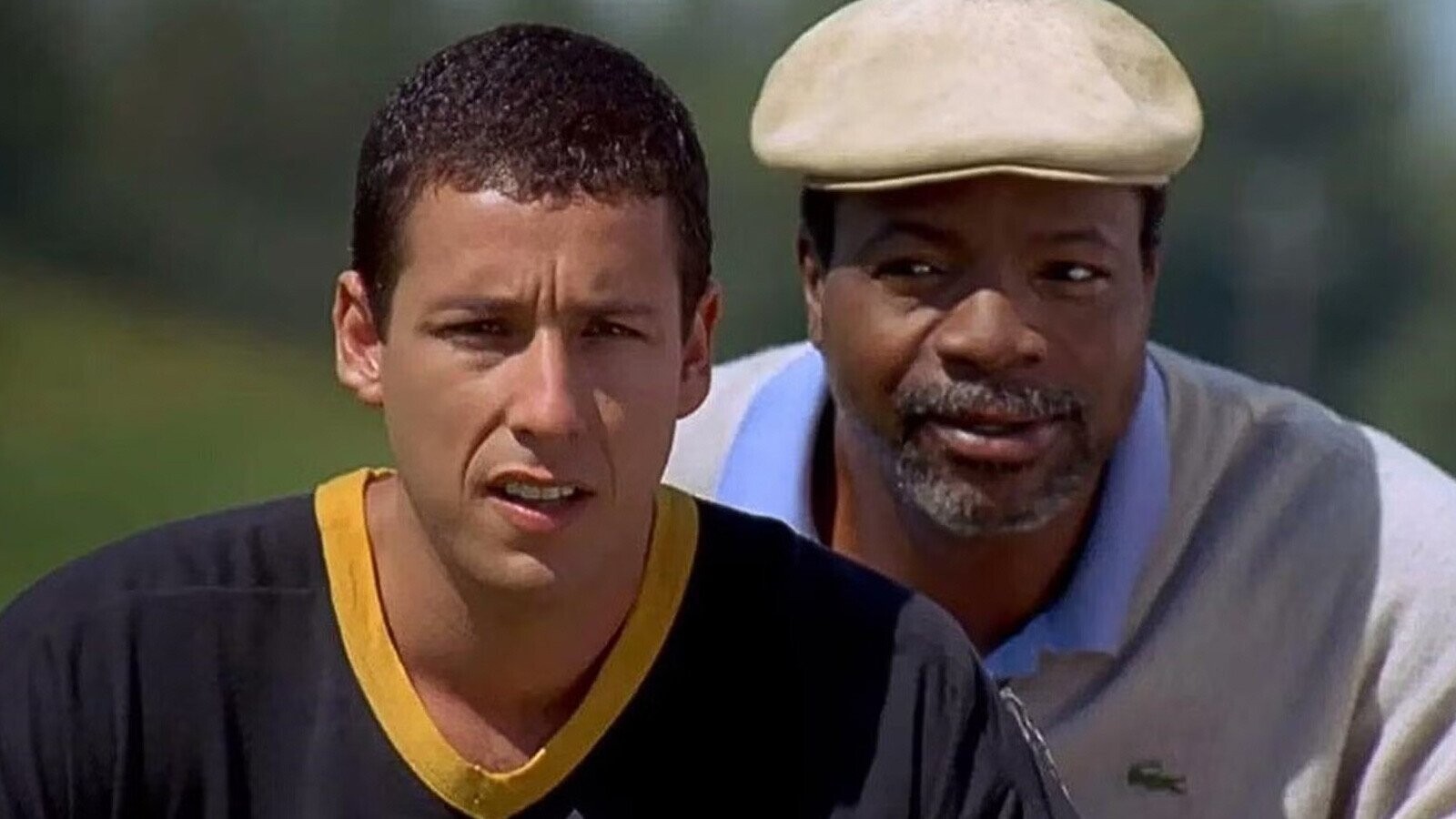
Before Happy Gilmore became one of the most quotable sports comedies of the 1990s, Adam Sandler and co-writer Tim Herlihy had a very reasonable panic attack. Not the “forgot your pants at school” kind of panic. More like the “we just made a golf comedy and our favorite movie ever is already the most famous golf comedy of all time” kind.
The movie haunting them was Caddyshack, Harold Ramis’ 1980 comedy classic starring Chevy Chase, Rodney Dangerfield, Ted Knight, Bill Murray, and one extremely committed gopher. For Sandler and Herlihy, Caddyshack was not just a film. It was the golf comedy. It was the clubhouse, the green jacket, the ridiculous hat, the whole bag of clubs. So when Happy Gilmore was nearing release, Sandler later admitted that he and Herlihy worried they had wandered onto sacred comedic grass wearing metal spikes.
The funny part, of course, is that Happy Gilmore did not replace Caddyshack. It joined it. The two movies became very different monuments to golf misbehavior: one a loose, anarchic country-club rebellion; the other a loud, hockey-powered underdog story about rage, family, and a swing that looks like it was invented during a parking lot argument.
So why did Caddyshack nearly keep Adam Sandler from releasing Happy Gilmore? The answer says a lot about comedy, creative insecurity, generational taste, and why sometimes the thing you fear being compared to is actually proof that your idea belongs in the conversation.
The Shadow of Caddyshack: Golf Comedy’s Untouchable Clubhouse
To understand Sandler’s hesitation, you have to understand what Caddyshack meant to comedy fans. Released in 1980, the film was messy, strange, loose, and proudly allergic to polite behavior. It turned a country club into a battlefield where old money, new money, caddies, weirdos, authority figures, and underground wildlife all fought for screen time.
It was not a tidy sports movie. Nobody watches Caddyshack for a clean tournament arc or a touching speech about discipline. People watch it for Rodney Dangerfield detonating country-club etiquette, Bill Murray mumbling his way into comic immortality, and Ted Knight behaving like someone personally insulted the entire concept of fun.
That is why the comparison scared Sandler and Herlihy. Making a golf comedy after Caddyshack was like opening a pizza place next to a beloved neighborhood joint whose owner knows everyone’s birthday and has somehow become mayor. Even if your pizza is great, customers will still ask, “But is it like the old place?”
For young filmmakers still proving themselves, that kind of comparison can be terrifying. Sandler had already made noise with Billy Madison, but Happy Gilmore was another test of whether his strange, shouty, oddly sweet comic style could carry a feature film. Herlihy, Sandler’s longtime friend and writing partner, shared the same fear. They were not just competing with a movie. They were competing with a personal favorite.
Adam Sandler and Tim Herlihy: A Comedy Partnership Built on Shared Taste
Adam Sandler and Tim Herlihy’s creative partnership began long before Happy Gilmore. They were college friends, comedy collaborators, and eventually partners in shaping some of Sandler’s most recognizable early movies. Their bond mattered because Happy Gilmore was not created by committee in a sterile conference room where executives asked, “Can the angry golfer have more brand synergy?” It came from a friendship, a shared sense of humor, and a mutual love of pop culture.
That shared love included Caddyshack. In interviews around the return of Happy Gilmore, Sandler has described how deeply he and Herlihy knew and loved that movie. That admiration became a creative problem. When you know every line of a classic, you also know exactly how badly you could fail by standing too close to it.
Many creators experience this. A novelist loves Stephen King and worries every creepy small town will sound like a knockoff. A filmmaker loves Martin Scorsese and suddenly every tracking shot feels like it needs a permission slip. Sandler and Herlihy loved Caddyshack, so writing another golf comedy felt dangerous. They were not afraid of golf. They were afraid of disrespecting the giant comedy statue already standing on the course.
Why Happy Gilmore Was Not Just Another Caddyshack
Here is the key: Happy Gilmore survived because it was not trying to be Caddyshack. It borrowed the setting of golf, but it changed the engine completely.
Caddyshack Was an Ensemble Riot
Caddyshack is built around competing comic personalities. It feels like a party where every guest is trying to hijack the microphone. The country club is the real main character, and the comedy comes from class conflict, absurd side plots, and performers bouncing off each other like golf carts with no brakes.
Happy Gilmore Was an Underdog Sports Story Wearing Steel-Toed Boots
Happy Gilmore, released in 1996, follows a failed hockey player who discovers he can crush a golf ball with monstrous power. His goal is simple and emotionally clear: save his grandmother’s house. That emotional hook gave the film a sturdy spine, even when the jokes were flying around like clubs after a tantrum.
Happy is not a country-club rebel in the same way Al Czervik is. He is a working-class outsider who genuinely does not belong in golf’s polished world. He screams, fights, breaks etiquette, and treats putting like an ancient curse. But underneath the chaos is a sweet motivation. He wants to help his grandmother. That is why audiences tolerated the yelling. Beneath the rage monster was a loyal grandson with terrible impulse control.
The Golf Course as a Comedy Battlefield
Golf is funny because it takes itself very seriously. The whispering, the tucked shirts, the sacred silence, the tiny ball, the enormous emotional collapse after missing a three-foot puttit is a sport built for comic disruption. Both Caddyshack and Happy Gilmore understood this perfectly.
Caddyshack mocked the country club as a social institution. It laughed at hierarchy, status, snobbery, and the idea that rich people in plaid pants are somehow guardians of civilization. Happy Gilmore mocked golf’s emotional restraint. It asked, “What if the quietest sport in America was invaded by a man whose indoor voice had been legally discontinued?”
That difference mattered. Sandler and Herlihy did not make a second Caddyshack. They made a sports comedy about anger crashing into etiquette. The result gave audiences a new comic fantasy: what if the guy who gets shushed at the driving range became the star?
Why the Fear Was Reasonable
Looking back, it is easy to laugh at Sandler’s hesitation because Happy Gilmore became a cult favorite. But at the time, the fear made sense.
First, golf comedies were not an endless genre. There were only so many major examples audiences could instantly name. Caddyshack towered over the category. Any new golf comedy would inevitably face comparison.
Second, Sandler’s early film career was still finding its long-term identity. His comedy was loud, absurd, juvenile, and occasionally weirdly tender. Critics were not always gentle. Some reviewers dismissed Happy Gilmore as silly or too broad, while audiences found the exact same qualities hilarious. That critic-audience split became a pattern in Sandler’s career: the people in the seats often had a much better time than the people holding notebooks.
Third, the movie’s premise was proudly ridiculous. A failed hockey player becomes a professional golfer because he can drive the ball absurd distances. That is not a “based on a true story” setup. That is a “somebody ate nachos at 1 a.m. and wrote down a dream” setup. It needed confidence, pace, and emotional simplicity to work.
The Bob Barker Fight: When Happy Gilmore Found Its Own Legend
Every comedy classic needs a scene that escapes the movie and becomes part of pop culture. For Caddyshack, there are several: the gopher, the pool scene, Bill Murray’s “Cinderella story,” Rodney Dangerfield’s one-liners. For Happy Gilmore, the signature moment is the Bob Barker fight.
The brilliance of the scene is how confidently stupid it is. A celebrity golf tournament collapses into a fistfight between Happy and the famously calm host of The Price Is Right. The joke works because Barker does not appear as a fragile cameo. He appears as a shockingly capable opponent. The scene is absurd, physical, and perfectly suited to Sandler’s universe, where anger often becomes slapstick ballet.
That scene helped Happy Gilmore become more than “the other golf comedy.” It created its own mythology. Nobody confuses Bob Barker throwing punches with Caddyshack. That is pure Happy Gilmore.
Shooter McGavin: The Villain Who Helped the Movie Age Well
Christopher McDonald’s Shooter McGavin is another reason the film stood apart. Shooter is not just a snob. He is a man who seems to believe golf is his personal monarchy. His finger-gun celebration, smug smile, and theatrical hatred of Happy made him one of the most memorable comedy villains of the era.
Great sports comedies need great opponents. Caddyshack had Judge Smails. Happy Gilmore had Shooter McGavin. Both characters represent gatekeeping, but Shooter is more directly tied to Happy’s journey. He is the polished insider facing the chaotic outsider. Every time Shooter tries to protect golf from Happy, he accidentally makes Happy more powerful. It is like feeding a gremlin after midnight, except the gremlin has a hockey stick and unresolved anger.
From Mixed Reviews to Cult Classic
When Happy Gilmore arrived in theaters in February 1996, it was not instantly treated as high art. That is probably because it was not trying to be high art. It was trying to make people laugh at a golfer yelling at a ball, and on that noble mission, it performed admirably.
The movie earned solid box office returns against a modest budget and gradually grew into a fan favorite. Over the years, it became especially beloved among golfers, casual sports fans, and Sandler audiences. Lines from the movie kept circulating. Shooter McGavin became a meme before memes fully took over the internet. Happy’s run-up swing became something people attempted at driving ranges, often followed by a second attempt to locate their spine.
That long afterlife proved Sandler and Herlihy’s fear wrong. Audiences had room for two golf comedies because the movies satisfied different comic appetites. Caddyshack was the wild party at the country club. Happy Gilmore was the guy crashing the tournament because his grandma needed help and his emotional regulation was still in beta testing.
What Happy Gilmore Reveals About Creative Risk
The story behind Sandler’s hesitation is more than a funny Hollywood anecdote. It is a useful lesson about creative risk. Many ideas look too similar from a distance. “Golf comedy” sounds narrow. But the difference is in point of view.
Caddyshack saw golf as a social circus. Happy Gilmore saw golf as an emotional obstacle course. Caddyshack laughed at institutions. Happy Gilmore laughed at rage, class discomfort, and the absurdity of forcing a hockey goon into a sport that treats breathing too loudly as a felony.
That is why originality does not always mean inventing a subject nobody has touched before. Sometimes originality means bringing a new comic personality into familiar territory. Sandler did not need to invent golf. He needed to invent Happy.
How Happy Gilmore 2 Reopened the Conversation
The release of Happy Gilmore 2 on Netflix decades later brought the original film’s legacy back into the spotlight. It also reminded fans how strange and durable the first movie’s reputation had become. A comedy that once made its creators nervous had become valuable enough to revisit nearly 30 years later.
That kind of longevity is rare for broad studio comedies. Many comedies burn brightly and then feel trapped in their release year. Happy Gilmore kept traveling because its central joke is still easy to understand: golf is quiet, Happy is not. Golf has rules, Happy has feelings. Golf values control, Happy swings like he is trying to settle a personal debt with the moon.
The sequel’s existence also adds irony to the original fear. Sandler once worried that Happy Gilmore could not stand beside Caddyshack. Years later, Happy Gilmore had become its own nostalgic landmark, strong enough to generate another chapter and bring old fans back to the course.
Why Audiences Had Room for Both Movies
Comedy fans do not love only one version of a premise. They love voices. Caddyshack and Happy Gilmore both use golf, but they speak different comic languages.
Caddyshack belongs to the late 1970s and early 1980s tradition of anti-establishment ensemble comedy. It is loose, rebellious, and built around performers with big personalities. Happy Gilmore belongs to the 1990s Sandler universe: emotionally simple, aggressively silly, packed with oddball side characters, and powered by a man-child hero who is somehow both unbearable and lovable.
One movie asks, “What if the country club is ridiculous?” The other asks, “What if the most emotionally unstable person you know becomes the face of professional golf?” Both are excellent questions. Neither should be asked at an actual PGA Tour press conference.
Experiences and Takeaways: What Creators Can Learn From Sandler’s Fear
The experience behind Happy Gilmore offers a practical lesson for anyone creating something in the shadow of a classic. Whether you are writing a screenplay, launching a blog, opening a business, producing a podcast, or making a comedy about a sport where pants have opinions, comparison is unavoidable. The mistake is believing comparison automatically means defeat.
Many creators stop too early because they confuse influence with imitation. They think, “Someone already made the great version of this.” But most subjects are big enough for multiple interpretations. Love stories did not end with Casablanca. Boxing movies did not end with Rocky. Golf comedies did not end with Caddyshack. The real question is not, “Has this topic been done?” The better question is, “What angle, emotion, character, or rhythm can I bring that was not there before?”
Sandler and Herlihy’s worry was actually a sign of respect. They were not casually copying a classic. They understood its importance so deeply that they feared embarrassing themselves beside it. That kind of fear can be healthy if it pushes creators to clarify their own identity. Happy Gilmore worked because it did not try to out-Caddyshack Caddyshack. It leaned into Sandler’s strengths: explosive anger, childish sincerity, bizarre side characters, and a hero whose heart is bigger than his vocabulary.
There is also a lesson in timing. In 1996, audiences were ready for Sandler’s style. His comedy had moved from stand-up and Saturday Night Live into movies, and fans wanted something different from polished studio comedy. Happy Gilmore gave them a sports movie that felt less like a motivational poster and more like a food fight at a driving range. That freshness mattered.
For modern creators, the message is simple: do not let the existence of a masterpiece bully you out of making something honest. Respect the classic, study why it works, then move in your own direction. The world rarely needs a copy. It often has room for a cousin, a rebel, a remix, or a loud hockey player who treats golf balls like they owe him rent.
Another useful takeaway is that audiences often decide legacy slowly. Critics may judge a comedy on opening weekend, but fans build its real life over years. They quote it, share it, rewatch it, introduce it to friends, and turn small moments into cultural shorthand. That is what happened with Happy Gilmore. The movie did not need to be universally praised on day one. It needed to connect with people strongly enough that they kept carrying it around.
Finally, Sandler’s story is a reminder that fear does not always mean stop. Sometimes fear means you care. Sometimes it means you are close to something that matters to you. And sometimes, if you are lucky, it means you are about to release a movie where Bob Barker punches your main character and somehow everyone agrees this was a good idea.
Conclusion: The Price Was Right, and So Was the Risk
Caddyshack nearly kept Adam Sandler from releasing Happy Gilmore because it represented the ultimate golf comedy in his mind. Sandler and Tim Herlihy loved it so much that making their own movie in the same broad territory felt risky, maybe even foolish. But that fear underestimated the power of a distinct comic voice.
Happy Gilmore did not need to defeat Caddyshack. It only needed to be itself. By combining a sports underdog story, Sandler’s explosive comic persona, a heartfelt family goal, unforgettable supporting characters, and one legendary Bob Barker brawl, the film carved out its own place in comedy history.
In the end, the story is not about one golf comedy replacing another. It is about how influence can inspire fear, and how the best creative response is not imitation, but transformation. Caddyshack may have been the intimidating clubhouse champion, but Happy Gilmore showed up, took a running start, and smashed its own ball into pop-culture immortality.












