
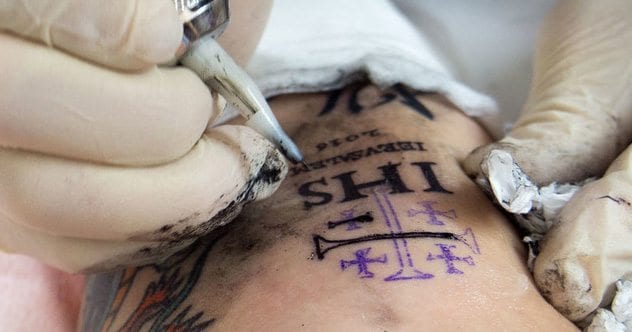
Long before tattoo shops had neon signs, sterilized chairs, and playlists that somehow always include one moody indie song, ancient people were already turning skin into a living canvas. The difference? Their ink was often made from soot, charcoal, or mineral pigments, and the “studio” might have been a frozen mountain pass, an Egyptian village, a Siberian burial chamber, or a Pacific island workshop where bone tools did the job with zero customer loyalty cards.
Ancient tattoos are mysterious because they rarely survive. Skin decays. Pigment fades. Burial, climate, looting, and time all conspire to erase the evidence. When tattoos do appear on mummies, figurines, tools, or preserved skin, they feel like messages accidentally delivered thousands of years late. Some may have been therapeutic. Others were protective, religious, decorative, erotic, elite, tribal, magical, or simply personal. In other words, ancient tattoos were not one thing. They were a whole human mood board.
Below are ten of the most fascinating ancient tattoos and tattoo-related discoveries known from archaeology. They come from real mummies, museum research, scientific imaging, and ancient art. The meanings are not always certain, which is exactly what makes them so compelling. Archaeology often gives us the ink, but not always the caption.
1. Ötzi the Iceman’s Charcoal Lines
Ötzi, the famous Copper Age mummy discovered in the Alps in 1991, is one of the most important tattooed bodies ever found. He lived more than 5,300 years ago and carried 61 tattoos across his body. These were not dragons, portraits, or inspirational quotes in elegant script. They were simple lines and crosses, made by cutting the skin and rubbing charcoal into the incisions.
The mystery is not whether Ötzi had tattoos. He absolutely did. The mystery is why. Many of his marks appear near joints and areas that show signs of physical strain, including his lower back, knees, ankles, and wrists. That pattern has led researchers to suggest that the tattoos may have had a therapeutic purpose, perhaps intended to relieve pain or treat chronic wear and tear. Think of it as Stone Age physical therapy, except with more charcoal and fewer insurance forms.
Ötzi’s tattoos are especially important because they challenge the modern assumption that tattoos began mainly as decoration. In his case, body marking may have been closer to medicine, ritual, or both. His skin tells us that ancient people were not merely surviving; they were experimenting with the body, pain, healing, and symbolism in sophisticated ways.
2. The Gebelein Man’s Bull and Barbary Sheep
The Gebelein Man, a naturally mummified Egyptian individual dating to around 3351–3017 B.C., spent more than a century in the British Museum before his tattoos were fully recognized. Under ordinary light, the marks on his arm looked like dark smudges. Infrared imaging revealed something far more dramatic: the shapes of a wild bull and what appears to be a Barbary sheep.
These are among the earliest known figurative tattoos in the world. That matters because they are not merely dots or lines; they depict recognizable animals. The bull may have symbolized power, masculinity, danger, status, or ritual authority. The sheep could have carried meanings tied to hunting, strength, or local belief systems. No one can say with absolute certainty, because Predynastic Egyptians did not leave us a convenient “tattoo meaning guide” with customer reviews.
What makes the Gebelein Man so mysterious is the combination of age, artistry, and delayed discovery. His tattoos were hiding in plain sight, waiting for modern technology to notice what the naked eye missed. The discovery also pushed back the history of tattooing in Africa by centuries and showed that men, not only women, were tattooed in early Egypt.
3. The Gebelein Woman’s S-Shaped Symbols
The Gebelein Woman, another naturally mummified individual from Predynastic Egypt, also revealed tattoos through infrared imaging. Her designs include S-shaped motifs and other markings on the upper arm and shoulder area. Unlike the Gebelein Man’s animals, her tattoos are more abstract, which makes them even harder to interpret.
The S-shaped designs may have been symbols of status, protection, ritual identity, or social belonging. Some scholars have compared them with motifs found in early Egyptian material culture, suggesting the marks may have had broader cultural meaning rather than being random decoration. Their placement on the body is also significant. Tattoos are not only about what is drawn; they are about where the design lives.
The Gebelein Woman is often discussed as one of the earliest known tattooed women. Her tattoos complicate old assumptions that ancient Egyptian tattooing was only linked to sexuality, entertainment, or lower status. Instead, her body suggests a more nuanced picture. Tattoos may have marked identity, social role, spirituality, beauty, or all of the above. Ancient people were rarely kind enough to keep their categories tidy for future historians.
4. The Deir el-Medina Woman Covered in Sacred Symbols
At Deir el-Medina, the Egyptian village known for the workers who built royal tombs, archaeologists identified the tattooed torso of a woman from the New Kingdom period. She was not marked with one or two discreet designs. She had more than 30 tattoos across her neck, shoulders, arms, and back.
Many of the images are religious. They include Wadjet eyes, lotus motifs, cows associated with the goddess Hathor, and other protective or divine symbols. Hathor was linked with music, fertility, sexuality, joy, motherhood, and the afterlife. In other words, she had range. The tattoos may have publicly connected the woman to Hathor’s worship, perhaps indicating a religious role or a special relationship with divine power.
This discovery is mysterious because the tattoos seem highly intentional and visible. Their placement may have allowed the woman’s body to function almost like a sacred object in motion. When she moved, performed, healed, prayed, or participated in ritual, the symbols moved with her. Her skin may have been a portable temple wall, which is far more impressive than a tote bag with a museum logo.
5. The Pazyryk Ice Mummies and Their Animal Combat Scenes
In the frozen tombs of Siberia’s Altai Mountains, Pazyryk mummies from the Iron Age have preserved some of the most spectacular ancient tattoos ever discovered. These tattoos often show animals in motion: deer, tigers, rams, goats, birds, and fantastic hybrid creatures. Some are twisted into dramatic poses, as if frozen mid-leap, mid-attack, or mid-myth.
The Pazyryk people were nomadic horse-riders who lived between roughly the sixth and third centuries B.C. Their tattoos appear on shoulders, arms, hands, and legs. Some designs show real animals, while others blend features into mythical beasts. One recurring creature has been described as a wild goat with an eagle’s beak and a panther’s tail. Ancient Siberian tattoo art clearly did not suffer from a lack of imagination.
Scholars have proposed that these tattoos may have served as magical protection, social identity, clan symbolism, elite display, or spiritual weaponry. The fact that many tattoos would have been covered by clothing raises an intriguing question: were they meant for other people to see, or for spirits, ancestors, and unseen forces? The Pazyryk mummies remind us that visibility is not always the point. Sometimes the most important symbol is the one hidden under a sleeve.
6. The 2,500-Year-Old Siberian “Ice Mummy” Revealed by New Imaging
Modern imaging has recently added fresh detail to the story of Siberian tattooing. High-resolution and near-infrared studies of a 2,500-year-old Pazyryk woman revealed tattoos that were previously difficult or impossible to see clearly. Her arms showed elaborate animal scenes, including leopards, deer, a stag fighting a griffin-like creature, and other complex compositions.
What shocked researchers was not just the subject matter but the technical skill. The designs suggest careful planning, steady hands, and possibly different tattooists or different sessions. Some details are so refined that modern tattoo artists would respect the line work. Ancient tattooing was not a casual “poke it and hope” situation. It could be a professional craft requiring training, tools, pigment preparation, and serious pain tolerance.
The mystery deepens because some tattooed skin appears to have been cut during burial preparation, suggesting that the tattoos may have mattered more in life than in death. That does not make them less meaningful. It makes them more human. They belonged to a living person with a body, status, beliefs, and experiences, not simply to a mummy in a display case.
7. The Tarim Basin Woman with Moons on Her Eyelids
The Tarim Basin in western China has produced some of the ancient world’s most intriguing mummies. Dry desert conditions preserved bodies, clothing, hair, and sometimes tattoos. One tattooed woman, dated roughly between 1000 and 600 B.C., had charcoal or soot-based designs that included moons on her eyelids, ovals on her forehead, and scroll-like patterns on her hand and wrist.
Moons on the eyelids sound almost too poetic to be real, but that is part of the fascination. Were these designs protective? Were they linked to vision, dreams, death, beauty, or ritual identity? Since eyelids are delicate and highly visible, the choice of placement was probably meaningful. Nobody accidentally tattoos moons on eyelids the way someone accidentally buys the wrong brand of cereal.
The Tarim tattoos are also mysterious because the region was a crossroads of peoples, languages, trade routes, and cultural influences. Tattooing there may have reflected local beliefs, migration, status, gender, or contact between groups. These mummies remind us that ancient Central Asia was not isolated. It was connected, mobile, and culturally layered.
8. Ancient Egyptian Figurines Showing Tattoo Patterns
Not all ancient tattoo evidence comes from preserved skin. In Egypt, Middle Kingdom faience figurines sometimes display patterns of dots, lines, diamonds, or geometric designs on the abdomen and thighs. These figures, sometimes called “Brides of the Dead,” are often associated with fertility, sexuality, femininity, music, dance, and religious life.
Some New Kingdom images also show women, especially dancers and musicians, with the dwarf god Bes tattooed on the thigh. Bes was a protective deity associated with childbirth, women, households, music, and celebration. He looks like a small fierce guardian who would absolutely win a staring contest. His placement on the thigh may have connected tattooing with protection, fertility, eroticism, or performance.
The mystery here is how closely these figurines reflect real bodies. Were they idealized? Ritual objects? Household charms? Offerings? A little of everything? Even if they are not portraits of specific tattooed individuals, they show that tattoo imagery had recognizable meaning in ancient Egyptian visual culture. Tattoos were not random scribbles. They belonged to a symbolic language that ancient viewers could read far better than we can.
9. The Fernvale Tattoo Tools from Ancient Tennessee
At the Fernvale site in central Tennessee, archaeologists identified sharpened turkey bone tools and pigment residues that may represent some of the oldest known tattooing tools in North America. The tools are dated to approximately 3500–1600 B.C., pushing direct evidence for tattooing in the region far deeper into the past.
The kit included sharpened bones that could have punctured skin and shells associated with pigment. Red and black pigment residues suggest that ancient tattooing involved prepared colors, tools, and technique. Since skin rarely survives in the southeastern United States, tools like these are crucial. They are the archaeological equivalent of finding the tattoo machine but not the tattoo.
The mystery is cultural context. What designs did these tools create? Who received them? Were tattoos connected to adulthood, kinship, healing, warfare, ceremony, mourning, beauty, or spiritual protection? Indigenous tattooing traditions in North America were rich and varied, but ancient physical evidence is rare. Fernvale gives us a rare glimpse of practice without preserving the finished art.
10. Ancient Polynesian Tattoo Tools and the Roots of Tatau
The English word “tattoo” ultimately comes from Polynesian tatau, famously recorded by Captain James Cook in the eighteenth century. But the practice itself is far older than European contact. Archaeological finds in Tonga and the wider Pacific include ancient bone tattooing implements, some dated to around 2,700 years ago.
These tools were often shaped into combs or blades and used with a tapping method. Ink was applied by striking the tool so pigment entered the skin. Some tools were made from bird bone, while others may have been made from human bone, a detail that adds a powerful layer of ancestry, ritual, and identity. A tattoo made with a human-bone tool would not simply decorate the body; it could connect the wearer to lineage, memory, and sacred authority.
Polynesian tattooing is mysterious not because it vanished, but because it survived, transformed, and endured. Its ancient roots continue to influence tattoo culture worldwide. The bold geometric patterns admired today are part of a much older oceanic tradition in which body art could communicate genealogy, rank, courage, adulthood, protection, and belonging.
Why Ancient Tattoos Still Fascinate Us
Ancient tattoos are powerful because they make the past feel close. A pot, blade, or wall painting can be beautiful, but a tattoo once lived on warm skin. It moved when someone lifted an arm, danced, prayed, worked, rode a horse, gave birth, hunted, healed, or walked through a village. Tattoos turn archaeology from “people made things” into “people had bodies.” That is a big emotional jump.
They also challenge lazy assumptions about ancient life. People thousands of years ago were not plain, primitive, or uninterested in personal expression. They styled hair, wore jewelry, painted faces, scarred skin, pierced bodies, dyed cloth, and tattooed themselves with astonishing creativity. The ancient world was not beige. It was colorful, symbolic, and sometimes very dramatic.
The mystery remains because tattoos sit at the intersection of art, pain, identity, religion, medicine, and memory. A single mark can mean many things at once. Ötzi’s lines may have been medical, but medicine itself may have had spiritual meaning. Egyptian Hathor tattoos may have been religious, but religion could also involve gender, performance, protection, and social identity. Pazyryk animal tattoos may have been elite display, magical armor, clan sign, or personal mythology. Human beings are complicated now; there is no reason to assume we were simpler in 3000 B.C.
Experience: What Studying Ancient Tattoos Teaches Modern Readers
Spending time with ancient tattoos changes the way you look at modern ink. At first, it is tempting to compare old tattoos with today’s designs and ask which ones are “better.” That misses the point. Ancient tattoos were made in completely different worlds, often with handmade tools, natural pigments, and cultural meanings we can only partially reconstruct. They were not trying to impress social media. They were doing something more permanent, personal, and risky.
One of the strongest experiences connected with this topic is the feeling of intimacy. Archaeology usually deals with distance: thousands of years, foreign languages, ruined sites, broken objects, missing names. Tattoos collapse that distance. When we learn that Ötzi had marks near painful joints, we suddenly imagine an aging body. When we see the Gebelein Man’s animals, we imagine someone choosing powerful creatures to carry on his skin. When we study the Deir el-Medina woman’s sacred designs, we imagine a person whose body may have been part of religious performance. These are not abstract cultures. These are individuals.
Another lesson is humility. It is easy to over-explain ancient tattoos because humans dislike uncertainty. We want every symbol to have one clean meaning: bull equals power, eye equals protection, moon equals goddess, and so on. Sometimes that may be partly true. But ancient symbols often worked like poetry. They gathered meaning from placement, body, ritual, gender, age, profession, family, and local belief. A tattoo might have meant one thing to the wearer, another to the community, and another to the dead. The past refuses to fit into a tidy caption, which is rude of it but academically healthy.
Ancient tattoos also make modern tattoo culture feel less like a trend and more like a continuation. Today, people get tattoos for grief, love, identity, recovery, beauty, rebellion, spirituality, humor, or because they lost a bet on vacation. Ancient people may not have shared our exact motives, but the emotional territory feels familiar. Bodies have always been used to carry stories that words cannot fully hold.
There is also a practical appreciation that comes from thinking about ancient tattooing tools. A modern tattoo machine moves rapidly and precisely. Ancient tattooing involved incisions, punctures, combs, tapping tools, soot, charcoal, bone, shell, and plant or mineral pigments. The process could be slow and painful. That means the decision to be tattooed was probably significant. Nobody casually endured hours of hand-tapping just because the design was “kind of cute.” Pain gave the mark seriousness.
Finally, these ancient tattoos remind us that the body itself is historical evidence. Skin can be an archive, even if a fragile one. Every preserved tattoo is a rare survival against decay. Every newly revealed mark is a small rescue mission from time. When infrared imaging uncovers a hidden animal or a faint sacred symbol, it feels almost like hearing a whisper from someone who did not know we would be listening thousands of years later.
Conclusion
The story of ancient tattoos is not a straight line from “primitive markings” to modern body art. It is a global web of healing practices, sacred symbols, social codes, artistic experiments, and personal choices. From Ötzi’s charcoal lines to Egyptian sacred eyes, Siberian animal battles, Tarim Basin moons, Tennessee bone tools, and Polynesian tattoo combs, ancient tattooing reveals a world where the human body was never merely biological. It was cultural, spiritual, social, and expressive.
The greatest mystery is not that ancient people tattooed themselves. The greatest mystery is how much meaning they managed to pack into marks that, thousands of years later, still make us lean closer. Tattoos may fade, but the human desire to be seen, protected, healed, remembered, and transformed clearly has excellent staying power.
Note: This article is written for web publication in standard American English and is based on established archaeological, museum, and scientific research about ancient tattooing.











