
Wall Street has a favorite measuring tape, and it is not revenue, profit, employee count, or the number of office plants quietly dying beside the accounting department. It is market capitalization.
Market cap influences how companies are labeled, how indexes are constructed, how investment funds allocate billions of dollars, and how investors interpret risk. It can determine whether a stock is treated like a dependable blue-chip battleship, a fast-growing speedboat, or a homemade raft held together by enthusiasm and unusually confident social-media posts.
Yet market capitalization is often misunderstood. A high market cap does not automatically mean a company is financially healthy, reasonably valued, or destined to dominate forever. It simply shows what the stock market currently believes the company’s outstanding equity is worth.
That “currently” matters. Market cap is powerful, useful, influentialand constantly changing.
What Is Market Capitalization?
Market capitalization, commonly shortened to market cap, is the total market value of a publicly traded company’s outstanding shares.
Market cap = current share price × total shares outstanding
Suppose Maple Street Robotics has 50 million outstanding shares trading at $40 each. Its market capitalization would be:
50 million × $40 = $2 billion
If the stock rises to $50 while the share count remains unchanged, the company’s market cap increases to $2.5 billion. No forklift arrives carrying an extra $500 million in cash. The market has simply raised the price it is willing to pay for the company’s equity.
This distinction is essential. Market cap is a market-based estimate, not an appraisal of every factory, patent, contract, coffee machine, and ergonomic chair owned by the business. It reflects the collective expectations of buyers and sellers, including their opinions about future earnings, competition, risk, growth, interest rates, and whatever headline appeared before breakfast.
Share Price Alone Tells You Almost Nothing About Company Size
A common beginner mistake is assuming that a $500 stock represents a larger company than a $25 stock. That is like judging the size of a pizza by the price of one slice without asking how many slices exist.
Company A might trade at $500 with 10 million shares outstanding, giving it a $5 billion market cap. Company B might trade at $25 with 4 billion shares outstanding, giving it a $100 billion market cap. Company B is twenty times larger by market capitalization despite having the much cheaper stock.
Stock splits make this even clearer. In a two-for-one split, the share count doubles while the price is adjusted to roughly half its previous level. Investors own twice as many shares, but the company’s market cap does not change merely because the corporate pizza was cut into smaller pieces.
The Market Cap Neighborhoods
Investors commonly divide publicly traded companies into market-cap categories. The boundaries are not universal, and index providers may use their own flexible breakpoints, but the following ranges are widely used:
- Mega-cap: $200 billion or more
- Large-cap: $10 billion to $200 billion
- Mid-cap: $2 billion to $10 billion
- Small-cap: $250 million to $2 billion
- Micro-cap: Less than $250 million
These labels are more than decorative name tags. They help investors estimate where a company may sit in its business life cycle and how its stock might behave.
Large-Cap and Mega-Cap Companies
Large-cap companies are typically established businesses with substantial operations, recognizable brands, broader access to financing, and more resources for surviving economic trouble. They may generate steadier cash flow and, in some cases, pay regular dividends.
However, large does not mean indestructible. Corporate history contains plenty of former giants that lost market share, misunderstood technological change, or confidently marched into a strategic wall. Size can provide resilience, but it cannot provide immunity from bad decisions.
Mid-Cap Companies
Mid-cap stocks occupy the awkward but interesting middle. These companies may have moved beyond their fragile startup years while retaining room to expand into new markets. They can offer a blend of growth potential and operational maturity.
Think of them as businesses that have learned where the light switches are but are still deciding how many floors the building should have.
Small-Cap and Micro-Cap Companies
Smaller companies may grow faster because they begin from a smaller base. A regional business can potentially become national, while a mega-cap corporation cannot simply discover another United States hiding behind the first one.
That potential comes with added risk. Small companies may depend on fewer products, customers, lenders, or executives. Their stocks can trade less frequently, experience wider price swings, and become harder to sell during market stress. Micro-cap stocks can be particularly vulnerable to limited disclosure, thin liquidity, promotional campaigns, and manipulation.
Why Market Cap Rules the Index World
Market capitalization becomes especially powerful inside stock indexes. Many major benchmarks use market-cap weighting, meaning larger companies receive larger positions.
If one company represents 6% of the combined capitalization of an index, it generally receives roughly a 6% weight, subject to the index’s specific rules. If another represents 0.10%, its effect on index performance will be correspondingly tiny.
This creates a straightforward system: the market itself determines position sizes. As a company’s stock rises relative to the rest of the index, its weight grows. If it falls, its weight shrinks. Index committees do not need to hold an emergency meeting every time traders change their minds before lunch.
Float-Adjusted Market Capitalization
Many indexes do not use every outstanding share. Instead, they use free-float market capitalization, which generally counts shares readily available for public trading while excluding certain strategic, insider, government, or controlling stakes.
Imagine a company with 100 million shares, but its founder and a corporate partner hold 70 million shares that are unlikely to trade. A float-adjusted index may base the company’s weight largely on the remaining 30 million shares. This can provide a more realistic picture of the equity actually available to investors.
Index providers also use modified weighting, concentration limits, rebalancing rules, and eligibility standards. For example, one index may follow raw listed market capitalization, while another may limit how much influence its largest constituents can have. Similar-sounding indexes can therefore produce different exposures and returns.
The Bigger They Get, the Louder They Speak
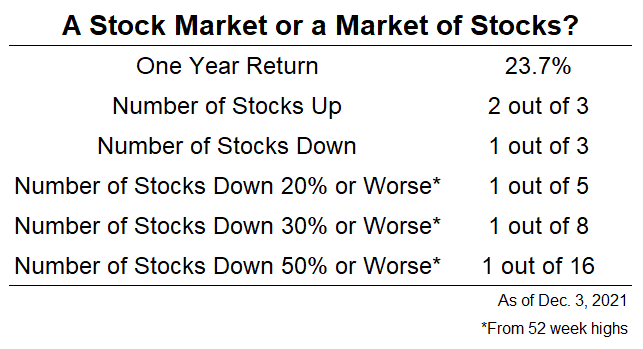
When a handful of mega-cap stocks occupies a large percentage of an index, their movements can dominate the financial headlines. Hundreds of smaller companies may rise while the index finishes lower because two or three giants had a rough afternoon.
The reverse can also occur. Most stocks may decline, yet a major benchmark stays positive because its largest members rallied. This is why investors sometimes say that “the market” is up even while many individual portfolios look at the statement and ask, “Which market?”
Concentration is not automatically good or bad. Successful companies become large because investors value their earnings, assets, competitive advantages, and expected growth. Cap weighting allows those winners to become meaningful parts of the index. The tradeoff is that investors may become increasingly dependent on a relatively small group of companies. By 2024, the ten largest U.S. stocks accounted for almost 30% of the Russell 1000 Index, illustrating how market leadership can shape broad benchmark performance.
Why Investors Like Market-Cap-Weighted Funds
Market-cap-weighted index funds have several practical advantages. They can provide broad exposure without requiring a manager to predict which companies deserve larger allocations. Their weights naturally adjust as prices change, which can reduce the amount of trading needed between formal rebalancing events.
They also represent the collective market portfolio reasonably well. Investors who own a broad cap-weighted fund are not making a separate active bet on every company. They are effectively accepting the market’s current pricing and allowing larger publicly traded businesses to occupy more space.
This approach is elegant, but it is not neutral in every possible sense. It creates greater exposure to companies after their market values have increased. Critics argue that this can cause investors to hold more of expensive stocks and less of potentially undervalued ones.
Supporters answer that the market’s biggest companies are not selected randomly. They often became large by generating profits, developing valuable products, buying competitors, or building durable networks. A cap-weighted strategy also avoids repeatedly selling successful companies simply because they have become successful.
Equal Weighting Changes the Bet
An equal-weighted index gives every constituent the same initial position. In a 500-stock equal-weighted portfolio, each company begins near 0.20%, regardless of size.
This reduces mega-cap concentration and increases exposure to smaller constituents. It also requires regular rebalancing: positions that have risen must be trimmed, while laggards must be increased. Equal weighting can outperform when smaller companies lead, but it can lag badly when the market’s largest businesses dominate.
Neither method is magic. Cap weighting bets more heavily on market leaders. Equal weighting adds a smaller-company tilt and a systematic rebalancing discipline. Choosing between them means choosing which set of tradeoffs you would rather explain to yourself during an uncomfortable year.
What Market Cap Does Not Tell You
Market cap is an excellent answer to one question: What is the market value of the company’s outstanding equity?
Problems begin when investors expect it to answer every other question too.
It Does Not Measure Profitability
A company can have a huge market cap and weak current earnings because investors expect rapid future growth. Another company can produce substantial profits while receiving a modest market cap because investors expect stagnation or decline.
It Does Not Include Debt
Market cap values common equity, not the entire operating business. Analysts often use enterprise value when they want a broader estimate that accounts for debt, cash, and certain other financial claims.
Two companies with identical market caps can have radically different balance sheets. One may possess more cash than debt. The other may be wearing a tower of loans like a financial Jenga set.
It Does Not Reveal Whether a Stock Is Cheap
A $20 billion company is not automatically cheaper than a $200 billion company. Valuation requires comparing price with something economically meaningful, such as earnings, cash flow, sales, assets, or estimated future performance.
Market cap is the price tag. It does not tell you whether the item deserves the price tag.
It Does Not Guarantee Liquidity
A company can have a large total valuation but a limited public float. If relatively few shares are available for trading, the stock may behave differently from another company with the same headline market cap and a widely dispersed shareholder base.
It Does Not Replace Business Research
Before buying an individual stock, investors should examine the company’s business model, competitive position, revenue sources, profitability, cash generation, debt, share issuance, management incentives, and material risks.
A public company’s Form 10-K can provide detailed information about its operations, financial statements, risks, legal issues, liquidity, and management’s discussion of results. Market cap gets you through the front door; due diligence checks whether the building has plumbing.
The Size Factor: Can Small Companies Outperform?
Company size has played a major role in financial research. The Fama-French framework, for example, includes a size factor commonly called SMB, or “Small Minus Big.” It measures the historical return difference between portfolios of smaller and larger companies.
The existence of a size factor does not mean small-cap stocks win every year, every decade, or every time someone enthusiastically posts a chart. Smaller companies can experience long periods of underperformance. Their results are influenced by valuations, interest rates, economic growth, credit availability, sector composition, and investor risk appetite.
A small-cap allocation should therefore be viewed as a strategic exposure, not a fortune cookie promising higher returns. Small companies may offer greater growth opportunities and potential return premiums, but investors must tolerate higher business risk, weaker liquidity, and deeper drawdowns.
How to Use Market Cap Without Letting It Use You
Start With the Formula
Always examine both the stock price and the number of outstanding shares. A low share price does not make a company small, cheap, or destined to rise.
Check Changes in the Share Count
Companies can issue shares to raise capital, compensate employees, or finance acquisitions. They can also repurchase shares. Even if the stock price stays unchanged, changes in outstanding shares can affect market capitalization and each shareholder’s percentage ownership.
Compare Companies Within Relevant Industries
A $10 billion software business and a $10 billion utility may have little else in common. Their growth rates, margins, capital requirements, debt levels, and competitive risks can be completely different. Market cap provides a common ruler, but it does not turn every company into the same object.
Know What Your Fund Owns
Do not assume that “broad market,” “large-cap,” or “technology index” means the same thing across products. Review the benchmark, weighting method, largest positions, sector exposure, rebalancing schedule, and concentration rules.
Market-cap rankings can also change index membership during periodic reconstitution. When companies move between size categories, funds tracking those benchmarks may need to buy or sell shares. That is one reason index reconstitution dates can generate unusually heavy trading activity.
Use Market Cap as One Portfolio Tool
A diversified stock allocation may include large-, mid-, and small-cap companies. The appropriate combination depends on the investor’s goals, time horizon, financial condition, and tolerance for volatility.
Owning several funds does not guarantee diversification if all of them are heavily concentrated in the same mega-cap stocks. Different labels can still conceal nearly identical top holdings. Read the ingredients before buying a second bottle of the same sauce.
Practical Experiences: What Market Cap Teaches Investors
The following experiences reflect common situations investors encounter when using market capitalization in real-world research and portfolio decisions.
Experience One: The “Cheap” $3 Stock
Many investors begin by searching for stocks with low prices. A $3 share appears to offer more opportunity than a $300 share because the imagination quickly jumps from $3 to $30. That would be a tenfold return, and tenfold returns look excellent in a calculator.
Then market cap enters the conversation and ruins the partyin a useful way.
The $3 company may have 10 billion outstanding shares, producing a $30 billion valuation. Reaching $30 would imply a $300 billion market cap. Suddenly, the apparently easy move requires the company to create or attract an additional $270 billion of equity value.
Meanwhile, the $300 stock may have only 20 million shares, giving it a $6 billion market cap. Its high share price says nothing about whether its overall valuation is excessive. The experience teaches a durable lesson: count the shares before daydreaming about the price.
Experience Two: Owning Five Funds but One Portfolio
Another investor may own an S&P 500 fund, a large-cap growth fund, a technology ETF, a Nasdaq-focused fund, and a “future innovation” fund. Five ticker symbols create the emotional comfort of diversification.
Looking at the holdings can reveal a different story. The same group of mega-cap companies may dominate every fund. Instead of five distinct strategies, the investor owns five overlapping routes to nearly the same destination.
Market-cap weighting explains why. The largest companies naturally receive the largest allocations across many benchmarks. Adding more cap-weighted funds does not necessarily add meaningfully different exposure.
The practical response is not to panic or sell everything before breakfast. It is to evaluate overlap, understand total position sizes, and decide whether the concentration is intentional.
Experience Three: The Small-Cap Patience Test
Small-cap investing often sounds exciting when described as owning tomorrow’s leaders before everyone else discovers them. The actual experience may involve years of watching large companies outperform while smaller holdings struggle with borrowing costs, inconsistent profits, and limited investor attention.
This is where portfolio theory meets human behavior. An allocation that looked reasonable in a spreadsheet can feel unbearable when it trails a popular benchmark quarter after quarter.
The lesson is not that small-cap stocks are defective. It is that diversification guarantees participation, not constant satisfaction. Every diversified portfolio contains something that looks disappointing at a given moment. Otherwise, it probably is not very diversified.
Experience Four: Watching an Index Rise Without You
An investor may own dozens of respectable companies and still underperform a broad index because a few mega-cap leaders delivered exceptional gains. This can create pressure to abandon the original strategy and buy whatever has already risen the most.
Market cap helps explain the performance gap. When the largest index members rally, their substantial weights magnify the benchmark’s return. A portfolio that limits individual positions will naturally lag during periods of narrow leadership.
That does not prove the diversified portfolio is wrong. It proves that every construction method behaves differently. A concentrated index can be difficult to beat while its leaders are winning and painful to own when leadership reverses.
Experience Five: Discovering That Bigger Is Not Better
A final turning point occurs when an investor stops treating market capitalization as a quality score. A trillion-dollar company can be wonderfully managed or dangerously overvalued. A small company can be innovative or one difficult quarter away from calling its lender with an unusually friendly tone.
Market cap describes size. Financial statements describe economic performance. Valuation ratios describe what investors are paying for that performance. Competitive analysis considers whether the performance can continue.
The strongest research combines all four. Market cap opens the file; it should never close the case.
Conclusion: Market Cap Rules, but It Is Not the Only Rule
Market capitalization shapes the modern investment landscape. It categorizes companies, determines index weights, guides fund construction, influences portfolio exposure, and helps explain why a few enormous stocks can pull an entire benchmark in either direction.
Its power comes from simplicity. Multiply the share price by the outstanding share count, and you have a fast estimate of the market’s equity valuation. That number provides useful information about company size, potential volatility, index influence, and portfolio positioning.
But market cap cannot tell you whether a business is profitable, financially secure, competitively protected, or sensibly priced. It cannot replace cash-flow analysis, balance-sheet research, risk assessment, or basic skepticism.
So yes, market cap rules everything around usor at least a surprisingly large portion of the investing world. Just remember that a ruler measures an object. It does not tell you whether buying the object is a brilliant investment or an expensive way to acquire regret.













