
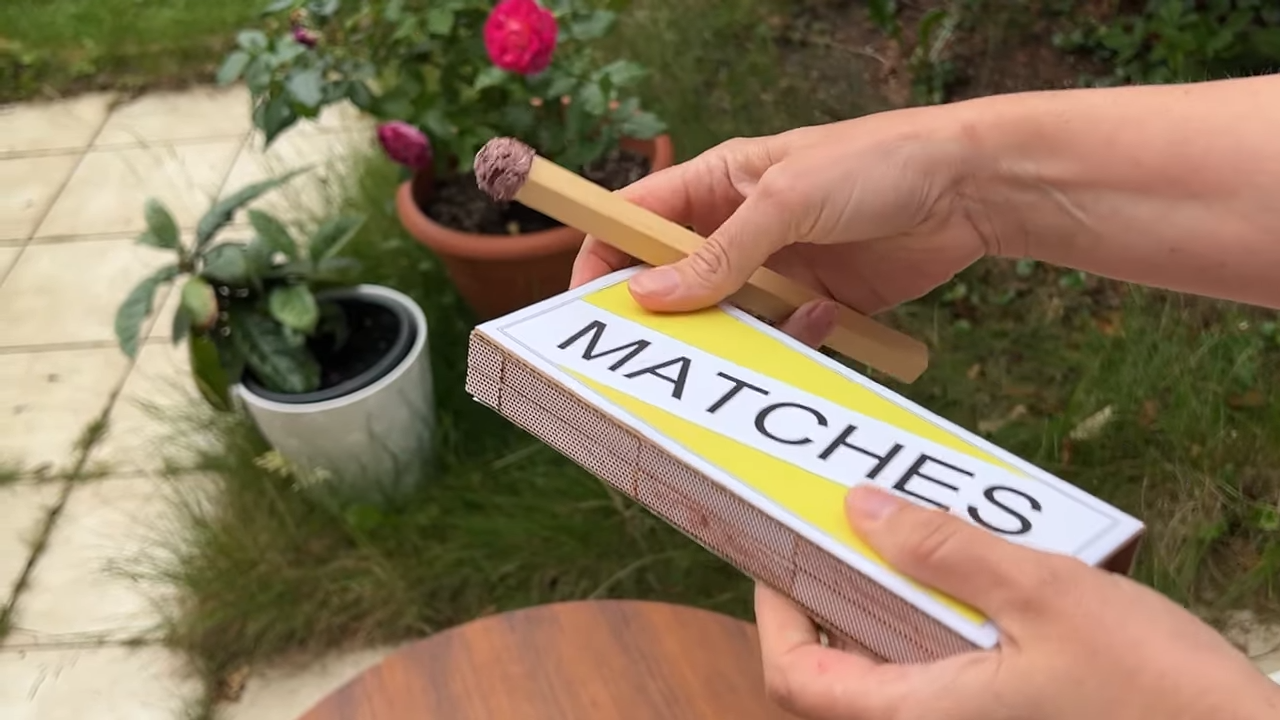
Some inventions solve problems nobody knew they had. Others take a perfectly serviceable object, enlarge it until it becomes ridiculous, and then ask an important scientific question: “Will this still work?” Giant functional matches belong proudly in the second category. They look like props stolen from a cartoon lumberjack, require a matchbox closer in size to a desk organizer, and produce enough flame to make an ordinary match seem emotionally unavailable.
The idea gained attention after a maker known as Handy Bear turned the oversized matches seen in a stage production into working versions. The concept was straightforward: use thick wooden shafts, give them enlarged combustible heads made from material associated with ordinary matches, and create a correspondingly huge striking surface. The result was not merely decorative. The matches ignited, produced an impressive flame, and burned long enough to suggest practical uses. Yet they did not completely behave like ordinary matches, which is exactly where the project becomes more interesting than a simple visual gag.
Research basis: Hackaday’s report and the original Instructables project.
Why Giant Matches Are So Funny in the First Place
Comedy often comes from violated expectations. We know how large a match should be. It is supposed to hide inside a small cardboard box, snap if handled carelessly, and make us lean forward while trying not to burn a fingertip. Scale that familiar object up several times and the brain needs a moment to renegotiate reality.
A giant match is instantly recognizable, but its proportions make ordinary actions look theatrical. Striking it becomes a full-arm gesture. Holding it resembles carrying a tiny torch. The oversized matchbox transforms a quick household task into something between a magic trick and a ceremonial opening of barbecue season.
That visual mismatch also explains why enlarged everyday objects work so well as stage props, store displays, public art, and online maker projects. The object needs no explanation. Everyone understands it immediately, and everyone also understands that it has become wonderfully unnecessary. It is visual humor with a flame at one end.
How a Safety Match Normally Works
To understand why a scaled-up match is only moderately effective, it helps to appreciate how carefully engineered a normal match is. A modern safety match is not simply a wooden stick wearing a spicy hat. It is a compact ignition system whose components are divided between the match head and the striking strip.
Friction Starts a Controlled Chemical Chain
The rough striking surface contains red phosphorus, while the head typically includes an oxidizing component such as potassium chlorate along with fuels, binders, fillers, and other materials. Friction creates localized heat and initiates a reaction that provides enough energy to ignite the rest of the head. That flame then transfers heat to the treated wooden splint.
This separation is a major reason safety matches are safer to transport than earlier match designs. The reactive ingredients are not all concentrated in the same place before use. Historical records also show how the match industry moved away from highly toxic white phosphorus toward safer red-phosphorus systems. A humble match represents generations of chemistry, manufacturing, worker-safety improvements, and countless people asking, “Could we make this less likely to poison the factory?”
Chemistry and historical context synthesized from ACS, the Science History Institute, and Smithsonian collections.
The Wooden Splint Is More Important Than It Looks
The shaft must catch fire reliably, burn at a useful rate, remain mechanically strong, and avoid glowing dangerously after the flame is blown out. Woods such as aspen have historically been used because they can be cut into uniform splints and perform predictably. Commercial matchsticks may also be treated to influence flame spread and reduce afterglow.
In other words, the stick is not merely a handle waiting for the interesting chemistry to happen. Its dimensions, moisture level, surface area, density, grain, and treatment all affect performance. When a maker swaps a slender splint for a chunky square dowel, the physics changes immediately.
Why Scaling Up Does Not Scale Performance Equally
If every dimension of an object grows, its volume increases faster than its surface area. That mathematical fact is the party pooper behind many giant-object experiments. A thicker wooden shaft contains much more material that must be heated before it can sustain combustion, but the burning head does not necessarily deliver heat in the ideal way or for enough time.
More Wood Means More Thermal Mass
A normal matchstick is thin. Heat from the head quickly raises the nearby wood to the point where it begins releasing combustible gases. A thick dowel absorbs far more energy. Its surface may char, smoke, or briefly support flame while the interior remains comparatively cool.
That helps explain the project’s funniest technical outcome: the head produces a dramatic flame, but the shaft may refuse to continue burning like a properly scaled ordinary match. The match looks ready to ignite a medieval beacon, then behaves more like a very enthusiastic appetizer.
A Larger Flame Is Not Automatically a Better Fire Starter
The oversized head can burn longer and create a broader flame than a standard match, which may make ignition easier in some controlled circumstances. However, starting a campfire depends more on fuel preparation than on theatrical ignition energy. Dry tinder, progressively larger kindling, airflow, weather conditions, and legal fire restrictions matter more than owning a match that could double as a parade baton.
A badly prepared fire lay will defeat a giant match. A properly prepared one can often be lit with a small match, a long fireplace match, or another commercially manufactured ignition tool. The scaled-up version provides reach and spectacle, but it does not repeal the basic rules of combustion.
What the Giant-Match Project Gets Right
It Turns Engineering Into an Easy-to-Understand Experiment
The project demonstrates a valuable maker principle: copying the shape of an object does not guarantee copying its behavior. Materials and proportions matter. A giant chair can still function because the forces remain manageable. A giant match must reproduce a tightly balanced sequence involving friction, ignition, heat transfer, gas release, flame spread, and burnout.
That makes the build a memorable example of scale effects. It invites questions about surface-area-to-volume ratio, heat capacity, fuel geometry, oxygen access, and why industrial products are often optimized far more deeply than their simple appearance suggests.
It Preserves the Object’s Visual Language
The enlarged matchbox matters almost as much as the matches. Without it, the wooden pieces might look like odd torches or craft-store dowels suffering from a rash. With the box and oversized striker, the entire system reads instantly as “match,” just at a size approved by giants.
This attention to visual consistency is what separates a compelling scale model from a random large object. The proportions, colors, packaging, and familiar striking motion complete the joke before the flame even appears.
It Produces a Real, Satisfying Result
Many oversized props are hollow shells. These matches actually ignite when struck on their matching surface. That functional payoff is why the project spread across maker communities: it combines spectacle with proof. The viewer does not merely see a giant match. The viewer watches it pass the one test that matters.
The imperfect burn arguably makes the project better. Total success would provide a quick “neat” moment. Partial success creates discussion. Why did the head work? Why did the wood resist? What would commercial match engineering do differently? Moderate effectiveness leaves room for curiosity, which is the maker world’s preferred renewable resource.
Practical Uses: Somewhere Between Tool and Party Trick
Could giant matches be useful? Yes, although “useful” needs to wear a slightly loose definition.
Lighting a Prepared Outdoor Fire
A longer shaft can keep a hand farther from the tinder and may provide more time to reach an awkward ignition point. Commercial fireplace matches already offer this benefit in a standardized form. An experimental giant match could theoretically light a prepared fire, but its bulk, storage needs, inconsistent burn, and homemade combustible head make it less sensible than purpose-built products.
Theater, Film, Displays, and Demonstrations
As a nonfunctional prop, an oversized match is excellent. It reads clearly from a distance, photographs well, and can support surreal or comic staging. For any production involving actual ignition, however, trained professionals, controlled environments, permits, fire-resistant surroundings, and venue-specific rules are essential. The safest giant match is often the one whose “flame” is fabric, light, or visual effects.
A Conversation Piece for Maker Culture
The project excels as an example of playful fabrication. It is the sort of object that attracts people across a workshop because everyone wants to know whether it works. It can open conversations about chemistry, product design, theatrical props, scaling laws, and risk assessment. Few educational objects announce their lesson while looking like they escaped from an oversized stationery drawer.
Safety Is the Part That Must Not Be Scaled Down
Potassium chlorate is a strong oxidizer, and authoritative chemical-safety guidance warns that it can intensify combustion and become hazardous when combined with incompatible combustible materials. Manipulating match-head compositions, creating large reactive masses, grinding energetic mixtures, or improvising chemical formulas can introduce fire, flash, impact, and friction hazards. This article analyzes the project; it is not a construction guide.
Matches should be treated as tools rather than toys, kept away from children, and used only where an open flame is permitted. Fire-safety authorities consistently emphasize adult supervision, working smoke alarms, clear escape planning, and secure storage of matches and lighters. Those recommendations apply even more strongly when the ignition source is unusually large or experimental.
Safety basis: ACS, PubChem, OSHA, USFA, CPSC, and NFPA guidance.
Outdoor use adds another layer of responsibility. Before lighting any fire, check local restrictions and weather. Use an established fire ring where required, clear nearby combustibles, keep water and a shovel available, keep the fire small, and never leave it unattended. Extinguish it by soaking, stirring, and repeating until everything is cool. A giant match may look hilarious; a wind-driven wildfire does not.
Current outdoor-fire guidance synthesized from the National Park Service, USDA Forest Service, and U.S. Fire Administration.
Safer Ways to Enjoy the Giant-Match Idea
The concept can be explored without manufacturing an enlarged ignition compound. Build a purely decorative version from lightweight wood or cardboard. Use a painted foam head. Create a fake flame with translucent fabric and LEDs. Design a giant matchbox as storage for ordinary fireplace matches. Make a classroom model that separates the “head” and “striker” components without containing reactive chemicals.
For actual fire lighting, use commercially manufactured long matches, an approved utility lighter, or another device designed and tested for the job. The charm of the giant-match project comes from its scale, not from taking avoidable chemical risks. There is no shame in letting the oversized version remain a comedian while a boring certified tool handles the fire.
Experience: What It Feels Like to Meet a Match That Has Been Supersized
The first reaction to a giant match is not technical. It is a laugh. The object arrives in the brain as a contradiction: completely familiar, obviously wrong. You recognize the shape before you comprehend the size. For a second, it seems possible that you have shrunk, the workshop has expanded, or a household item has been promoted to management.
Holding one changes your relationship with the ordinary striking motion. A normal match is controlled mostly by fingers and wrist. A scaled-up version asks for the forearm, elbow, and a surprising amount of confidence. The action feels less like lighting a candle and more like starting a ceremonial torch relay for people who take backyard grilling far too seriously.
The oversized box adds another layer of delight. Opening it is absurdly formal. Instead of pinching a tiny tray, you slide out something that could store pencils, paintbrushes, or several emergency granola bars. The striker occupies enough real estate to look like a piece of industrial sandpaper. Everything says that an enormous event is about to occur, even when the final goal is merely producing one flame.
Then comes ignition. A successful strike delivers the project’s best sensory moment: friction, a sudden flash, a broad orange flame, and the instant understanding that the joke has become real. People tend to step back even when they already know what is coming. The flame looks proportionate to the object, but disproportionate to the casual expectations built around the word “match.” It is a tiny campfire temporarily attached to a stick.
The experience also reveals why the match is only moderately effective. After the impressive head burns, attention shifts to the wooden shaft. Viewers expect the flame to march down the giant stick exactly as it would on a normal match. Instead, the thick wood may char and hesitate. The visual promise outruns the thermal performance. It is like watching a monster truck clear the first ramp and then politely refuse to climb a curb.
That failure is educational rather than disappointing. You can see the struggle between heat and mass. The head delivers energy rapidly, but the bulky wood absorbs it. The exterior darkens while the interior acts as a heat sink. An everyday lesson in geometry becomes visible without a graph: making something twice as thick does not simply make it twice as match-like.
There is also a practical revelation. When a giant match is used near a carefully arranged pile of dry tinder, the longer reach and sustained flame feel genuinely convenient. You are not racing a tiny burning stick toward the center of the fire lay. There is time to position the flame and let the tinder catch. For a moment, the object stops being a novelty and becomes a tool.
But the convenience arrives with baggageliterally. The matchbox is bulky. The matches need protected storage. The experimental heads demand more caution than ordinary commercial products. Carrying them on a camping trip would be like packing a floor lamp because your flashlight button feels small. They can work, but efficiency is not the joke’s strongest department.
The best overall experience is therefore a mixture of surprise, admiration, and mild skepticism. The scaled-up match succeeds as a spectacle, a functional prop, and a lesson in design. It performs its core trick while exposing the compromises hidden by enlargement. Most importantly, it reminds us that playful engineering does not need to solve a major problem to be worthwhile. Sometimes the reward is discovering exactly how much science is hiding inside an object that costs a few cents.
Conclusion: A Big Flame, a Bigger Lesson
Scaled-up matches are hilarious because they turn a forgettable household tool into a theatrical event. They are moderately effective because the chemistry of ignition can be enlarged more easily than the carefully balanced burn behavior of a commercial matchstick. The project works well enough to impress, fails just enough to teach, and looks ridiculous enough to be memorable.
Its real value is not as a replacement for ordinary matches. It is a demonstration of how scale changes performance, how much engineering hides inside simple products, and why successful maker projects often combine curiosity with humor. Build the visual idea safely, leave reactive chemistry to controlled and qualified settings, and remember: when an object becomes ten times larger, responsibility should grow at least as quickly.
Note: This article discusses an experimental maker project for educational and analytical purposes. Do not dismantle matches, concentrate match-head material, or create enlarged ignition compounds. Use commercially manufactured fire-lighting tools and follow all local fire rules.












