
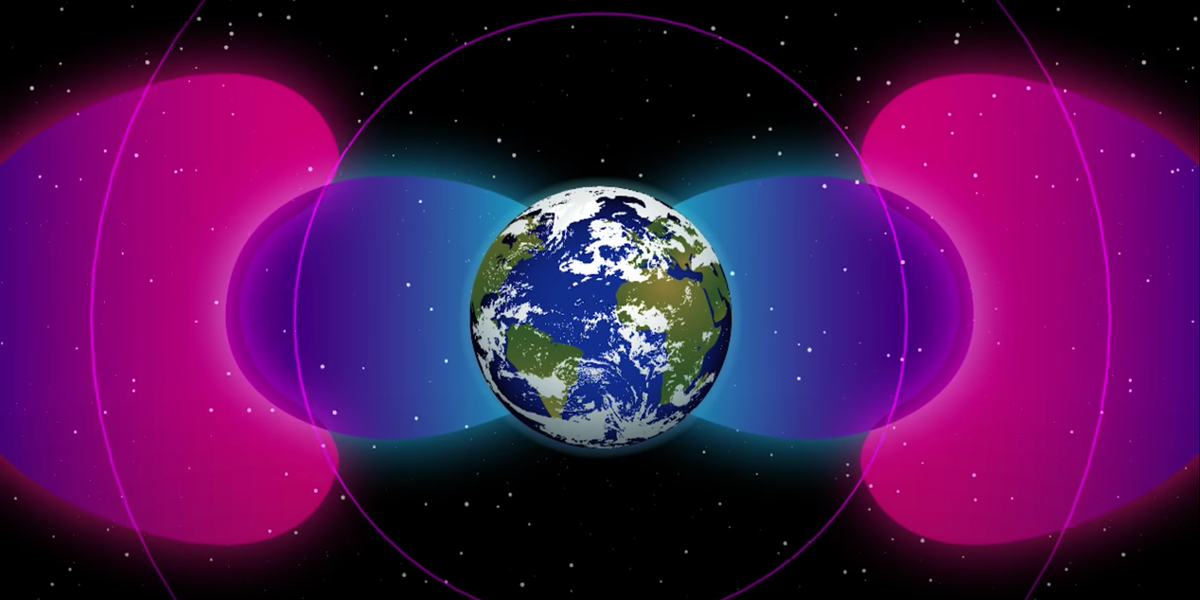
Imagine humanity accidentally building a giant invisible bubble around Earthnot with steel, concrete, or a suspiciously overfunded sci-fi laser, but with radio waves. It sounds like the opening scene of a blockbuster where someone in a lab coat says, “This was not in the simulation.” Yet this “human-made barrier around Earth” is real, and scientists have studied it using NASA’s Van Allen Probes.
The barrier is often described as a VLF bubble, created by very low frequency radio waves transmitted from Earth. These waves were not designed to protect the planet. They were mainly used for long-distance communication, especially with submarines. But some of that radio energy leaks upward, travels into near-Earth space, and interacts with charged particles trapped in the Van Allen radiation belts.
So, does this artificial barrier protect us? The answer is: yes, a littlebut not in the superhero force-field way the internet sometimes makes it sound. It may help push certain high-energy particles farther from Earth and influence the radiation environment around satellites. However, it does not replace Earth’s natural defenses: the magnetosphere, atmosphere, and ozone layer. Think of it less like Captain America’s shield and more like an unexpected umbrella that happens to open during a drizzle of space particles.
What Is the Human-Made Barrier Around Earth?
The human-made barrier around Earth is an invisible region shaped by very low frequency radio waves, usually called VLF waves. These radio waves occupy a low-frequency part of the electromagnetic spectrum and are useful because they can travel long distances and penetrate seawater better than many other radio signals.
That seawater detail matters. For decades, powerful VLF transmitters have been used to send signals to submarines. The original purpose was communication, not planetary defense. But Earth is not a closed radio box. Some VLF energy travels upward through the atmosphere and ionosphere, then enters the magnetosphere, where it can interact with energetic particles.
NASA’s Van Allen Probes detected this VLF bubble in near-Earth space. Researchers found that the outer boundary of this bubble lines up with the inner edge of the Van Allen radiation belts in a way that strongly suggests human radio transmissions have influenced the near-Earth radiation environment.
The Van Allen Belts: Earth’s Donut-Shaped Radiation Zones
To understand the barrier, we need to talk about the Van Allen belts. No, they are not fashionable accessories for astronauts. They are huge, donut-shaped regions of energetic charged particles trapped by Earth’s magnetic field.
The Van Allen belts were discovered in 1958, early in the space age. They contain high-energy electrons and protons that can be hazardous to spacecraft, satellites, and astronauts. The belts are dynamic, meaning they do not sit calmly in space like polite museum exhibits. They swell, shrink, intensify, and shift in response to solar storms, geomagnetic activity, and waves inside the magnetosphere.
Why the Radiation Belts Matter
The radiation belts are important because modern life depends on space technology. GPS, weather forecasting, satellite internet, television, aviation navigation, military systems, and global communications all rely on spacecraft operating in or near harsh radiation environments.
Energetic particles can damage satellite electronics, degrade solar panels, interfere with sensors, and create charging problems on spacecraft surfaces. Astronauts passing through these regions also need careful mission planning to reduce radiation exposure. That is why scientists study the belts so closely: the more we understand them, the better we can protect technology and people in space.
How Do VLF Radio Waves Create a Barrier?
The VLF bubble forms because radio waves from Earth can interact with charged particles in space. These interactions are part of a process called wave-particle interaction. That phrase sounds like something invented to make college physics students reconsider their life choices, but the basic idea is simple.
Charged particles in Earth’s magnetic field spiral and bounce along magnetic field lines. VLF waves can resonate with some of these particles, changing their motion. In certain cases, the waves scatter particles so that they fall into Earth’s upper atmosphere, where they lose energy and are removed from the radiation belts.
This process can reduce the number of energetic particles in parts of near-Earth space. Over time, the presence of strong VLF transmissions appears to have helped shape a boundary that keeps some radiation belt particles farther away than they might otherwise be.
Is It Really a “Barrier”?
Yes, but with an asterisk the size of a satellite dish. The word “barrier” can be misleading if we picture a solid wall around Earth. This is not a metal shell, a dome, or a glowing blue shield that makes dramatic humming noises.
The human-made barrier is better understood as a region of electromagnetic influence. It is a bubble of radio-wave activity that can affect how energetic particles behave. It does not stop every form of space radiation. It does not block solar flares at the source. It does not protect Earth from asteroids, cosmic rays, or your neighbor’s questionable Wi-Fi password.
Does the Human-Made Barrier Protect Us?
The short answer is: it may provide some protection in near-Earth space, especially for satellites, but it is not Earth’s main shield.
Earth’s primary protection comes from the magnetosphere, the huge magnetic environment generated by our planet’s interior. The magnetosphere deflects much of the solar wind and helps protect Earth from harmful charged particles. Below that, the atmosphere absorbs and filters additional radiation. These natural systems are the real MVPs.
The VLF bubble appears to add a smaller, human-made influence. By interacting with particles in the radiation belts, it may help keep some high-energy particles from moving closer to Earth. This could reduce certain risks to satellites and spacecraft operating in affected regions.
What It Does Protect
The barrier may help reduce the intensity of some charged-particle populations in near-Earth space. That matters most for satellites and spacecraft electronics. A less intense radiation environment can mean fewer radiation-related problems for sensitive instruments, circuits, and onboard systems.
It may also help scientists develop future methods for active radiation belt remediation. That means intentionally using waves to reduce hazardous particle populations after intense solar storms. In plain English: one day, we might use controlled radio waves to tidy up parts of space after the Sun throws a tantrum.
What It Does Not Protect
The VLF barrier does not make Earth immune to space weather. Strong solar storms can still disrupt radio communications, affect GPS accuracy, increase satellite drag, damage spacecraft systems, and induce electrical currents in power grids.
It also does not protect people on the ground in any direct, everyday sense. You do not need to thank submarine communications every time you forget sunscreen. Ground-level protection from harmful radiation mainly comes from the atmosphere, ozone layer, and magnetosphere.
Why NASA’s Van Allen Probes Were So Important
NASA’s Van Allen Probes were twin spacecraft launched to study Earth’s radiation belts. They traveled through the belts and measured particles, plasma waves, and magnetic fields. Their mission helped scientists understand how radiation belts gain and lose particles, how they respond to solar activity, and how human-made waves may influence them.
Before missions like this, the near-Earth radiation environment was much harder to understand. Space is not empty; it is a restless ocean of particles, fields, waves, and solar weather. The Van Allen Probes gave researchers detailed measurements from inside the action, rather than forcing them to guess from afar like someone trying to review a restaurant by sniffing the parking lot.
How Human Activity Is Changing Near-Earth Space
The VLF bubble is part of a broader idea called anthropogenic space weather. “Anthropogenic” means human-caused. We often use that word when discussing climate change, pollution, or land use, but human activity also affects the space environment around Earth.
Examples include radio transmissions, high-altitude nuclear test effects from the mid-20th century, spacecraft operations, rocket exhaust, and the rapidly growing population of satellites and space debris. The VLF barrier is unusual because it may be a human-made effect with a helpful side, though scientists are careful not to oversell it.
A Helpful Accident, Not a Free Pass
It is tempting to look at this discovery and say, “Great! Humans accidentally made a shield. We are geniuses.” Let us be humble. This was not a planned planetary protection system. It was a side effect of communication technology.
Also, not every human influence in space is beneficial. Space debris, radio interference, and satellite congestion create serious challenges. The VLF bubble is fascinating because it reminds us that Earth’s environment does not stop at the clouds. Our technology reaches into near-Earth space, sometimes in surprising ways.
Could We Use VLF Waves to Protect Satellites in the Future?
Scientists have studied whether VLF waves could be used intentionally to remove dangerous charged particles from radiation belts. This concept is sometimes called radiation belt remediation. The idea is to use waves to scatter energetic particles into the atmosphere before they damage satellites or threaten astronauts.
In theory, this could be useful after major solar storms, when radiation belts can become more intense. If carefully controlled, wave-based techniques might help reduce hazards in targeted regions. However, this is not simple. Space is complex, and pushing on one part of the magnetosphere can produce effects that need to be understood carefully.
Any future use of VLF waves as a protective tool would require detailed modeling, monitoring, and international coordination. Space is shared territory. You do not want one country “cleaning up” radiation in a way that accidentally causes problems for another country’s satellites. Even in orbit, good manners matter.
Common Myths About the Human-Made Barrier Around Earth
Myth 1: It Is a Physical Wall
No. It is not a wall, shell, dome, or artificial atmosphere. It is an electromagnetic region created by VLF radio waves interacting with charged particles.
Myth 2: It Protects Everyone from All Radiation
No. It may help influence some radiation belt particles, but Earth’s natural magnetosphere and atmosphere remain the main protective systems.
Myth 3: It Was Built on Purpose
No. The barrier was an unintended result of powerful VLF transmissions, especially those used for submarine communication.
Myth 4: It Means Space Weather Is No Longer a Threat
Definitely not. Solar storms can still disrupt satellites, radio systems, GPS, aviation, and power infrastructure. Space weather remains a serious field of study because our technology is increasingly vulnerable to solar activity.
Why This Discovery Is So Fascinating
The human-made barrier around Earth is exciting because it shows how connected our planet is to space. We often imagine Earth as separate from the cosmos, wrapped safely in blue skies. But above those skies is a magnetic environment that responds to the Sun, cosmic radiation, and even human technology.
This discovery also changes how we think about responsibility. If our radio waves can affect near-Earth space, then our actions have a larger footprint than we once imagined. The edge of human influence is not the coastline, the city limit, or even the top of the tallest skyscraper. It extends into the radiation belts.
Real-World Examples: Why Space Radiation Matters
Space radiation is not just a problem for astronauts in shiny helmets. It affects systems that ordinary people use every day. When space weather disturbs satellites, GPS signals can become less accurate. Communication links can degrade. Satellite operators may need to put spacecraft into safe mode. Airlines may adjust polar routes during radiation storms. Power-grid managers may monitor geomagnetic activity to reduce the risk of induced currents.
In other words, space weather is not distant trivia. It is part of modern infrastructure. The human-made VLF bubble matters because even a modest reduction in harmful particles could be valuable in an age when thousands of satellites support life on the ground.
Experience-Based Reflection: What This Topic Teaches Us
One of the most interesting experiences related to learning about the human-made barrier around Earth is the moment you realize that “space” is not as far away as it feels. Most people think of space as something separate from daily life: rockets, astronauts, telescopes, moon dust, dramatic movie music. But the VLF bubble shows that everyday human systems can reach far beyond the ground.
Consider the experience of using GPS on a road trip. You tap a destination, complain that the route includes three left turns too many, and trust satellites orbiting above Earth to guide you. Those satellites operate in a region shaped by Earth’s magnetic field, solar activity, and radiation belts. If space weather becomes intense, navigation accuracy can suffer. Suddenly, the invisible environment above us becomes very practical. It is not just science; it is whether your phone confidently sends you to the correct coffee shop or to a mysterious gravel road named “almost there.”
Another relatable experience is listening to radio signals during storms or traveling through areas with poor reception. Radio waves are sensitive to the ionosphere, the electrically active layer of Earth’s upper atmosphere. Solar activity can change that layer. VLF waves, because of their long wavelengths and unusual propagation behavior, can travel through the Earth-ionosphere system and sometimes escape into space. That means the same broad family of physics that affects radio communication also plays a role in shaping the artificial bubble detected by spacecraft.
For students, this topic is a perfect doorway into space science because it begins with something familiar: communication. We understand sending signals. We understand phones, radios, antennas, and Wi-Fi. From there, the story expands into magnetic fields, charged particles, radiation belts, and solar storms. It is like walking into a small classroom and discovering that the back door opens directly into the universe.
For engineers and satellite operators, the experience is more serious. Radiation is a design challenge. Spacecraft electronics must be hardened, shielded, tested, and monitored. A satellite is not simply launched and forgotten like a cosmic paper airplane. It must survive charging events, energetic particles, temperature swings, and orbital changes. Understanding whether human-made VLF waves can reduce some radiation hazards could help improve future space infrastructure.
For the average reader, the biggest takeaway is humility. Humanity accidentally changed near-Earth space, and in this case, the effect may be partly helpful. But that does not mean every technological footprint is harmless. The same species that created a protective radio bubble also created orbital debris and increasing competition for radio spectrum. The lesson is not “humans fixed space.” The lesson is “humans are now active participants in Earth’s space environment, so we should act like responsible adults.” Admittedly, responsible adults do not always have the best track record, but hope springs eternal.
The human-made barrier around Earth also gives us a rare optimistic science story. Many environmental stories focus on damage, loss, or risk. This one is different. It shows that careful research can reveal unexpected interactions, and that technologies designed for one purpose may teach us something valuable about another. Submarine communication systems were not built to influence radiation belts, yet their signals helped scientists discover a new piece of the Earth-space puzzle.
That experienceseeing a hidden connectionis what makes the topic memorable. Earth is not just a rock with weather. It is a magnetic, atmospheric, technological, solar-connected system. The human-made barrier is one strange and wonderful reminder that our planet is wrapped in layers of protection, some ancient and natural, one surprisingly modern and accidental.
Conclusion: A Bubble, Not a Miracle Shield
The human-made barrier around Earth is a real and fascinating phenomenon. It is created by very low frequency radio waves that leak from powerful ground-based transmitters into near-Earth space. These waves interact with charged particles in the Van Allen radiation belts and may help keep some energetic particles farther from Earth.
Does it protect us? Yes, but only in a limited and specific way. It may help protect satellites and spacecraft by influencing the radiation environment. It does not replace the magnetosphere, atmosphere, or other natural shields. It is not a magical defense system, and it does not make space weather harmless.
Still, the discovery is remarkable. It proves that human technology can affect not only land, sea, and air, but also the space surrounding our planet. The next time someone says radio is old technology, remember: some radio waves may be helping shape a bubble around Earth. Not bad for something that also brings us weather alerts, submarine messages, and occasionally a station playing the same song six times before lunch.












